Table of Contents
Our Services
Connect With Us
Your device’s class decides who licenses you, which forms you file, and who audits your factory. Here is how CDSCO assigns it, what each class means in practice, and how to work out your own in six steps.
Quick answer
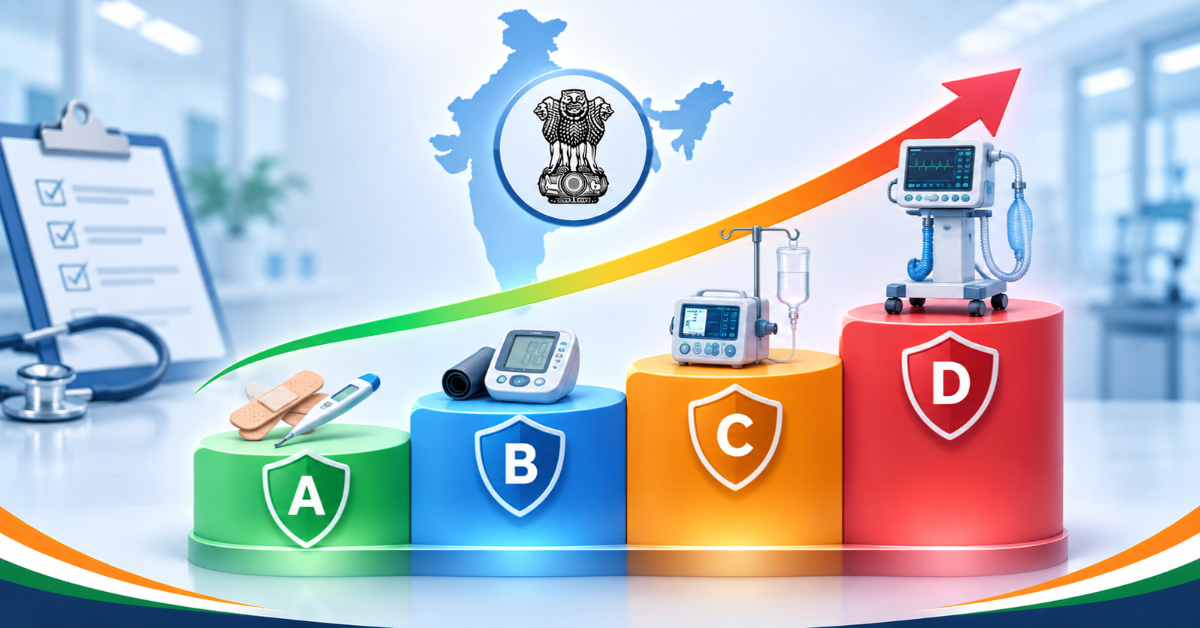
Under India’s Medical Devices Rules, 2017 (First Schedule), CDSCO classifies medical devices into four risk-based categories: Class A (Low Risk), Class B (Low-to-Moderate Risk), Class C (Moderate-to-High Risk), and Class D (High Risk).
- Class A Low risk. Examples from CDSCO lists: airway device cleaning utensil, manual surgical retractors.
- Class B Low to moderate. Examples: digital thermometer, blood pressure monitor.
- Class C Moderate to high. Examples: nebulizer, MRI equipment, defibrillator.
- Class D High. Examples: intra-aortic balloon system, bioresorbable coronary scaffold.
- What sets the class: intended purpose, how invasive the device is, how long it stays in contact with the body, and whether it uses active energy.
- Who licenses it: State Licensing Authorities (SLA) license Class A and B manufacturing. The Central Licensing Authority (CLA, CDSCO) licenses Class C and D manufacturing and all imports (non-sterile, non-measuring Class A is exempt from licensing).
If you are building a thermometer, importing a ventilator or launching a diagnostic app, the first regulatory question is the same: which class is it? A wrong answer sends you to the wrong licensing authority, the wrong forms and the wrong audit. It is the most expensive mistake you can make at the start, and the cheapest one to avoid.
Most guides stop at a list of Class A–D examples. This one also shows you how CDSCO decides a borderline case, what each class costs you in process terms, and where the common traps are. Where a fact comes from a specific notification, we name it so you can check it.
How Does CDSCO Classify Medical Devices in India? (MDR 2017 and the First Schedule)
CDSCO classifies a device by its intended use and the risk parameters in the First Schedule of the Medical Devices Rules, 2017: Part I for devices, Part II for in-vitro diagnostics. The Central Licensing Authority has the final say and publishes class-wise lists on the CDSCO website.
Rule 4 of the Medical Devices Rules, 2017 (MDR 2017) sets the four classes for both categories. The rules came into force on 1 January 2018 under the Drugs and Cosmetics Act, 1940. The First Schedule then supplies the criteria:
- Part I covers devices other than IVDs. It looks at how invasive the device is, how long it is used, whether it is active, and which part of the body it touches.
- Part II covers in-vitro diagnostic (IVD) devices, which are classified by their intended diagnostic use and the consequence of a wrong result.
CDSCO’s notice of 1 November 2017 published the first class-wise list and stated that the list is dynamic and subject to revision. It has been revised repeatedly since, including a merged category-wise classification PDF dated 15 October 2025 and revised drafts for cardiovascular and neurological devices in 2025. Always work from the current list, not from an old blog post. If you are new to the regulator itself, start with What is CDSCO? Full form, role and SUGAM portal guide.
The 4 Medical Device Risk Classes in India (With Real-World Examples)
Class A is the lowest risk and Class D the highest. Higher class means more documents, more scrutiny, and a central rather than state regulator. The examples below come from CDSCO class-wise notices; treat them as indicative and check the current list for your exact device.
Class A Medical Devices (Low Risk, Including Non-Sterile/Non-Measuring vs Sterile/Measuring)
Class A devices carry the lowest risk, but “Class A” alone does not tell you whether you need a licence. The split that matters is whether the device is sterile or has a measuring function.
- Risk Low (First Schedule, Part I)
- Examples Airway device cleaning utensil; manual surgical retractors
- Non-sterile and non-measuring Exempted from the licensing regime by G.S.R. 777(E) dated 14 October 2022. CDSCO’s FAQ also carves these devices out of the licence requirement for import and manufacture.
- Sterile or measuring Licensed.Manufacturing: State Licensing Authority (Form MD-3 application, MD-5 licence). Import: CDSCO (Form MD-14, MD-15).
- Licensing mandatory since 1 October 2022 for Class A and B
“Sterile” means supplied sterile. “Measuring” means the device has a measuring function. Confirm both attributes against your own labelling and claims.
Class B Medical Devices (Low-to-Moderate Risk)
Class B devices pose a low-to-moderate risk and are licensed for manufacture by the State Licensing Authority. This is where many home-use and monitoring products land.
- Risk Low to moderate
- Examples Digital thermometer; blood pressure monitoring device (both in CDSCO’s notice of 15 May 2019)
- Manufacturing SLA. Application Form MD-3, licence Form MD-5. Loan licence: MD-4 and MD-6.
- Import CDSCO. Form MD-14 application, MD-15 licence.
- Facility audit By a Notified Body registered with CDSCO
- Licensing mandatory since 1 October 2022
Class C Medical Devices (Moderate-to-High Risk)
Class C devices carry a moderate-to-high risk and move manufacturing approval to CDSCO itself. Many powered, therapeutic and imaging devices sit here, including some that look simple.
- Risk Moderate to high
- Examples Nebulizer; MRI equipment; defibrillator; dialysis machine; X-ray machine (CDSCO notice of 15 May 2019). Glucometers are classed C in the IVD list.
- Manufacturing CLA (CDSCO). Application Form MD-7, licence Form MD-9. Loan licence: MD-8 and MD-10.
- Import CDSCO. Form MD-14, MD-15.
- Licensing mandatory since 1 October 2023
Look at the pairing. A digital thermometer and a blood pressure monitor are Class B, while a nebulizer is Class C. The class follows intended use and risk, not how familiar the product looks.
Class D Medical Devices (High Risk)
Class D is reserved for devices where failure can endanger life, typically implants and devices in direct contact with the heart, central circulatory system or central nervous system.
- Risk High
- Examples Intra-aortic balloon system; bioresorbable coronary vascular scaffold; cerebrovascular occlusion catheter (CDSCO classification lists)
- Manufacturing CLA (CDSCO). Form MD-7 application, MD-9 licence.
- Import CDSCO. Form MD-14, MD-15.
- Licensing mandatory since 1 October 2023
Some stent-type products change class by design. In the same CDSCO list, a bioresorbable scaffold is Class D while a bifurcation stent is Class C. Check the exact device name.
Complete CDSCO Classification and Licensing Comparison Table (Class A vs B vs C vs D)
Class decides the licensing authority, the forms and the audit route. Class A and B go to the State Licensing Authority for manufacturing. Class C and D go to CDSCO. Every imported device, whatever its class, goes to CDSCO, except non-sterile, non-measuring Class A.
| What changes | Class A non-sterile, non-measuring | Class A sterile or measuring | Class B | Class C | Class D |
|---|---|---|---|---|---|
| Risk level | Low | Low | Low to moderate | Moderate to high | High |
| Manufacturing authority | Exempt from licensing (G.S.R. 777(E), 14 Oct 2022) | State Licensing Authority | State Licensing Authority | Central Licensing Authority (CDSCO) | Central Licensing Authority (CDSCO) |
| Manufacturing forms | Not applicable while exempt | Apply MD-3, licence MD-5 | Apply MD-3, licence MD-5 | Apply MD-7, licence MD-9 | Apply MD-7, licence MD-9 |
| Loan licence forms | Not applicable | MD-4, MD-6 | MD-4, MD-6 | MD-8, MD-10 | MD-8, MD-10 |
| Import authority and forms | Exempt (CDSCO FAQ) | CDSCO: MD-14, MD-15 | CDSCO: MD-14, MD-15 | CDSCO: MD-14, MD-15 | CDSCO: MD-14, MD-15 |
| Manufacturing site audit | None under licensing | Notified Body registered with CDSCO | Notified Body registered with CDSCO | CDSCO (CLA) audit or inspection | CDSCO (CLA) audit or inspection |
| Licensing mandatory from | Not applicable | 1 Oct 2022 | 1 Oct 2022 | 1 Oct 2023 | 1 Oct 2023 |
| Indicative examples | Airway device cleaning utensil | Check the CDSCO list for sterile or measuring variants | Digital thermometer, BP monitor | Nebulizer, MRI, defibrillator | Intra-aortic balloon system |
Scroll sideways on a phone. Government fees are set in the Second Schedule of MDR 2017 and vary by class, so confirm the current schedule before budgeting.
Two more registrations sit outside this table. Retailers, wholesalers and stockists of devices need a registration certificate (Form MD-42, applied for in MD-41) from the State Licensing Authority under G.S.R. 754(E) dated 30 September 2022. Importers of Class A to D devices should also read our CDSCO import licence guide for Forms MD-14 and MD-15. For the full filing route, see CDSCO medical device registration in India.
How to Determine Your Medical Device Class in 6 Steps (First Schedule Rules)
Write down your intended purpose, check CDSCO’s published list, then test the device against contact duration, invasiveness and energy source. If more than one rule applies, the highest class wins.
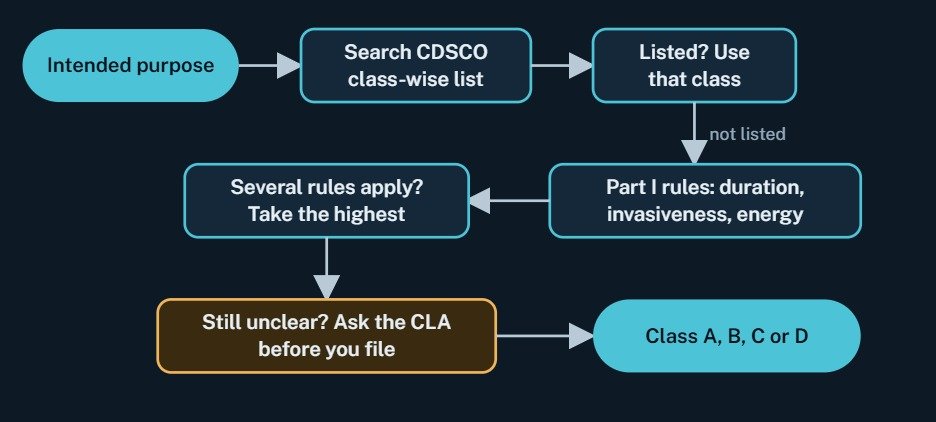
CDSCO class decision path. Part II applies instead of Part I when the product is an IVD.
Write the intended purpose statement
Class follows intended use, not the technology. Write what the device does, on which patient group, for how long and with what claims. Your labelling and marketing must match it, because a stronger claim can raise the class.
Check CDSCO’s official class-wise lists
Search the current category-wise lists on cdsco.gov.in (24 categories, from anaesthesiology to software). If your device is listed, that class is the starting point. IVDs have their own list.
Measure contact duration
Use the MDR definitions: transient is under 60 minutes of continuous use, short term runs from 60 minutes to 30 days, and long term is more than 30 days.
Map invasiveness and body site
Decide whether the device touches intact skin, injured skin, a body orifice, or is surgically invasive or implanted. Then ask whether it contacts the heart, central circulatory system or central nervous system. Typical patterns in Part I, summarised: a reusable surgically invasive device for transient use is Class A, short-term surgically invasive use is generally Class B, and implantable or long-term surgically invasive devices are generally Class C. Direct contact with the heart, central circulatory system or central nervous system, or life-supporting function, pushes a device toward Class D. Read the exact rule text before relying on this summary.
Decide whether it is active, and what it does
An active device depends on electrical or other non-body, non-gravity energy. Active therapeutic and active diagnostic devices are defined separately in MDR 2017, and energy delivery or monitoring of vital functions often raises the class.
Apply the highest-class tie-breaker
If two rules point to different classes, use the higher one. CDSCO’s FAQ applies the same logic across borders: if an imported product is classed differently in a GHTF-member country, the higher class is considered in India.
Same family, different classes
| Device (CDSCO list) | Class | Why it matters |
|---|---|---|
| Digital thermometer | B | Measuring function but low harm potential |
| Blood pressure monitoring device | B | Non-invasive monitoring |
| Nebulizer | C | Delivers medication by inhalation |
| Glucometer (IVD) | C | IVD result drives treatment decisions |
Not sure which class applies?
Send us your intended use statement and a one-page device description. TraccGlobal’s CDSCO specialists will confirm your risk class and the licence route before you spend on a dossier.
Special Classification Rules: IVDs, Accessories, Combination Devices and SaMD
IVDs follow Part II of the First Schedule. Accessories are classified separately from the main device. Combination products and software need extra care because the class depends on intended use and function.
IVDs (Part II)
In-vitro diagnostics use the same four classes but different criteria, based on intended diagnostic use and the impact of an incorrect result. CDSCO’s 15 May 2019 notice classed glucometers under IVDs as Class C. File IVD import applications in Form MD-14 and note that IVD test and performance-evaluation routes use their own forms.
Accessories and dual-use devices
CDSCO’s 2017 classification notice states that components and accessories are classified separately from the parent device or companion IVD. It also recognises that some devices have dual use and may be classified accordingly. Do not assume an accessory inherits the class of the main product.
Drug-device combinations
If a product combines a device with a medicinal substance, the primary mode of action and the regulator’s view of the combination drive the pathway. This is a case for early clarification. Our team covers it under drug-device combination products.
Software as a medical device (SaMD)
CDSCO issued draft guidance on medical device software on 21 October 2025 and has since published final guidance (reference CDSCO/MD/GD/MDSW/01/2026.1, reported in July 2026). Both separate software in a medical device (SiMD), which is embedded in hardware, from SaMD, which runs on its own. Under the draft, SiMD takes the class of the hardware device, while SaMD is classified by intended use, how significant its information is to clinical decisions and how serious the condition is. Check the final text for your product, because the guidance clarifies how existing rules apply rather than creating a separate scheme.
Notified vs Non-Notified Medical Devices in India: What Changed After S.O. 648(E)?
Before 2020, only “notified” devices were regulated, so non-notified devices needed no licence. S.O. 648(E) of 11 February 2020 brought all medical devices into the regulatory net from 1 April 2020, and licensing was then phased in by class.
A July 2014 DCGI office order had said that devices not notified by the Health Ministry needed no registration, licence or NOC under the old Drugs and Cosmetics rules. That loophole is closed. Today “notified” survives mainly as a label in CDSCO’s classification lists.
- 1 January 2018MDR 2017 comes into force, with the first class-wise list published on 1 November 2017.
- 11 February 2020S.O. 648(E) notifies all devices as “drugs” from 1 April 2020. G.S.R. 102(E) sets a phased timeline.
- 1 October 2022Licensing becomes mandatory for Class A and B. Applicants who had applied by 30 September 2022 got a continuity window.
- 14 October 2022G.S.R. 777(E) exempts non-sterile, non-measuring Class A devices from the licensing regime.
- 1 October 2023Licensing becomes mandatory for Class C and D.
CDSCO has also classified large numbers of previously non-notified devices and IVDs through notices issued after the 2020 amendment, which is why you should search the list even for a product you assumed was unregulated.
Common Classification Mistakes That Delay CDSCO Approval (For Startups and Importers)
Most delays come from classifying by habit rather than by rule: copying another country’s class, trusting an outdated list, or letting marketing claims drift from the intended purpose.
- Copying the US or EU class. Class I, IIa or IIb does not translate cleanly to A–D. For imports, CDSCO takes the higher class when classifications differ between GHTF-member countries and India.
- Using a stale list. The classification lists are revised, including 2025 revisions to cardiovascular and neurological devices. Pull the current PDF on the day you file.
- Assuming Class A means no licence. Only non-sterile, non-measuring Class A is exempt. Supply the device sterile or give it a measuring function and you need a licence.
- Letting claims outgrow the intended use. A website or brochure that adds a diagnostic or therapeutic claim can raise the class after you have built the file.
- Ignoring accessories and software. Accessories are classified separately, and standalone software is classified by function. Budget for them in the plan.
- Choosing SLA or CLA by company size. The authority follows class and import status, not turnover. Check the matrix above before you pick a portal route.
- Filing before the class is confirmed. Your Device Master File, risk file and audit route all depend on it. Confirm first, then build.
Once the class is settled, the next work is the quality system. Most Class B to D applications rely on an ISO 13485 aligned QMS, which you can scope through our medical devices regulatory services and our ISO 13485 QMS support. Indian manufacturers can read the licence route in our CDSCO manufacturing licence guide.
Confirm Your Device Class for Free With TraccGlobal’s CDSCO Experts
We review your intended use and tell you the likely class, the authority (SLA or CLA), the forms and the audit route. It is a pre-submission check, not a sales form.
Send us:
- Your intended use statement and target users
- Whether the device is sterile, measuring, active, implantable or software
- Duration of body contact and body site
- Where it is made, and whether you plan to import or manufacture in India
Frequently Asked Questions (CDSCO Risk Classification and Licensing)
How many medical device classes are there in India?
There are four: Class A (low risk), Class B (low-to-moderate), Class C (moderate-to-high) and Class D (high risk). Rule 4 of the Medical Devices Rules, 2017 sets them, and the First Schedule gives the criteria: Part I for devices and Part II for in-vitro diagnostics.
Who decides the class of my medical device?
The Central Licensing Authority at CDSCO classifies devices and publishes class-wise lists on its website. You can propose a class from the First Schedule rules, but the CLA has the final word. If your device is not listed or sits on a borderline, ask CDSCO for clarification before filing.
Does a Class A device need a licence?
Not always. Non-sterile, non-measuring Class A devices were exempted from the licensing regime by G.S.R. 777(E) dated 14 October 2022. Class A devices that are supplied sterile or have a measuring function are licensed, and Class A and B licensing has been mandatory since 1 October 2022.
Which classes go to the State Licensing Authority and which to CDSCO?
State Licensing Authorities license the manufacture of Class A and Class B devices. The Central Licensing Authority at CDSCO licenses the manufacture of Class C and Class D devices and the import of all classes.
Which forms apply to each class?
Manufacturing of Class A and B uses Form MD-3 for the application and MD-5 for the licence, with MD-4 and MD-6 for loan licences. Class C and D manufacturing uses MD-7 and MD-9, with MD-8 and MD-10 for loan licences. Imports of all classes use Form MD-14 for the application and MD-15 for the licence.
Do all medical devices now need a licence in India?
Almost all do. S.O. 648(E) of 11 February 2020 brought all medical devices under regulation from 1 April 2020. Licensing became mandatory for Class A and B on 1 October 2022 and for Class C and D on 1 October 2023. The main exception is non-sterile, non-measuring Class A.
Is a device unregulated if it is not on CDSCO’s notified list?
No longer. Before 2020 only notified devices were regulated, but S.O. 648(E) extended regulation to all devices that meet the definition of a medical device. Search the current CDSCO classification lists and, if you find no entry, seek clarification instead of assuming exemption.
What if the US or EU class differs from the Indian class?
CDSCO’s FAQ says that where an imported product is classified differently in a GHTF-member country, the higher class is considered in India. Do not transfer a US FDA or EU MDR class directly. Check the Indian list and First Schedule rules.
How is software classified as a medical device in India?
CDSCO’s guidance on medical device software separates software embedded in a device (SiMD) from standalone software (SaMD). Under the draft guidance, SiMD takes the class of its hardware, and SaMD is classified by intended use, the significance of the information it provides and the severity of the condition. Confirm details against the final guidance for your product.
How much does licensing cost and how long does it take?
Government fees are set in the Second Schedule of MDR 2017 and differ by class and by whether you manufacture or import, so confirm the current schedule before budgeting. Timelines depend on class, documentation quality and queries. TraccGlobal can map both for your device during a free classification check.