
Quick answer
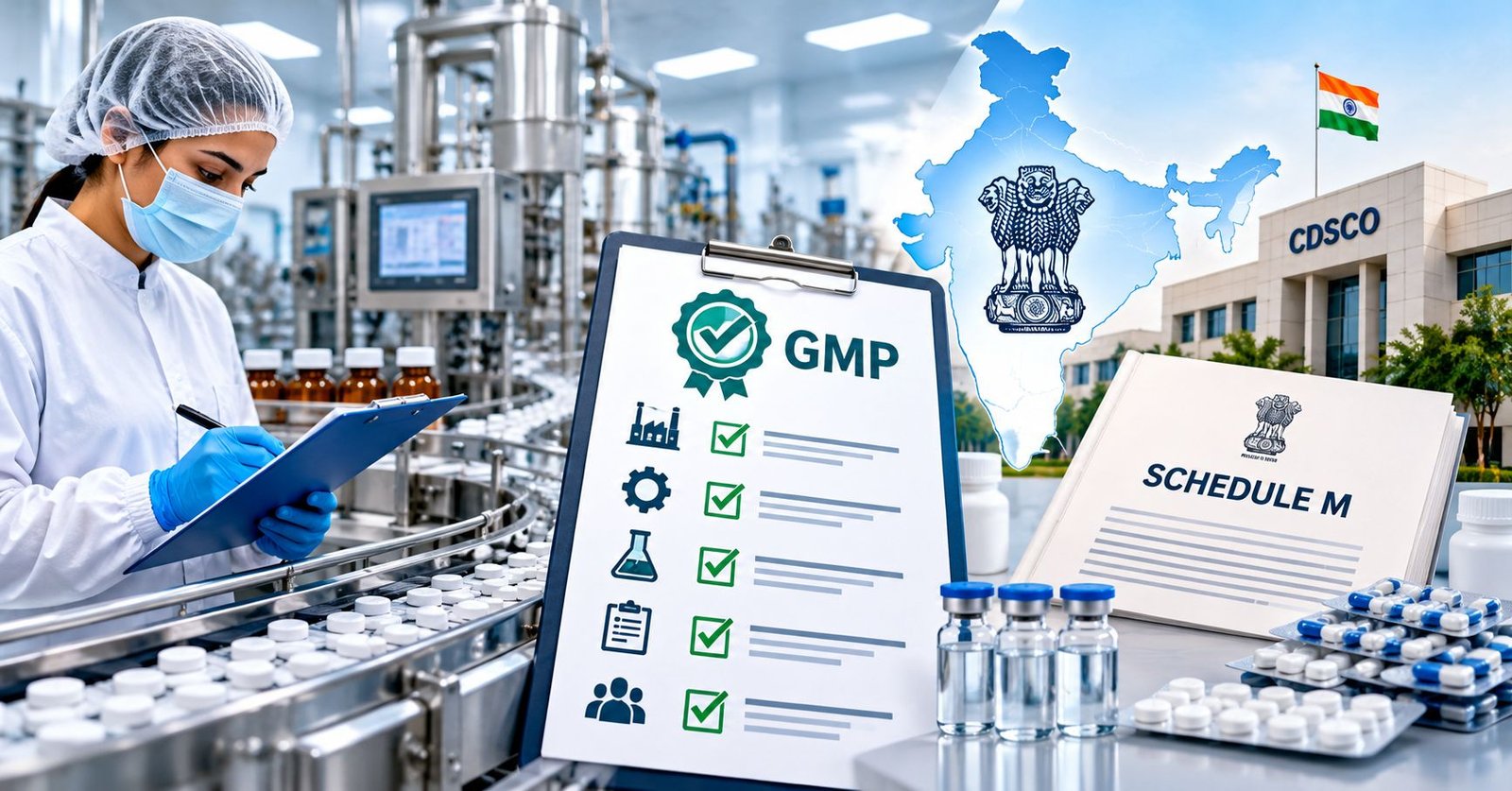
GMP compliance means a pharmaceutical manufacturer consistently makes and controls medicines to the quality standards their licence and intended use require, and can prove it with records. In India, the legal standard is Schedule M of the Drugs Rules, 1945, revised through G.S.R. 922(E) on 28 December 2023.
Why GMP compliance matters
Medicines cannot be judged by looking at them. A tablet with the wrong strength, a vial with a contaminant or a mislabelled pack looks the same as a good one. GMP puts the safeguard in the system: controlled premises, trained people, validated processes and complete records, so quality is built in rather than only tested at the end.
For an Indian manufacturer, the stakes are also legal and commercial. GMP requirements sit inside the conditions of the manufacturing licence, so weak compliance can lead to notices, suspension of licences or product approvals, recalls and lost buyers. Regulators have also made Schedule M enforcement a stated priority since 2025 (see below).
What GMP compliance covers
| Area | What it means in practice |
|---|---|
| Pharmaceutical quality system | Senior management owns quality; roles, resources, a quality manual and periodic management review are in place. |
| Personnel and training | Qualified key staff, production and quality heads independent of each other, written job roles, hygiene rules and recorded training. |
| Premises and layout | Design that prevents mix-ups and cross-contamination, logical flow of people and materials, pest control, controlled lighting, temperature and humidity. |
| HVAC, water and utilities | Air-handling systems and pharmaceutical water systems that are designed, qualified and monitored for the products made. |
| Equipment and calibration | Suitable, cleanable equipment; calibration schedules; cleaning procedures; status labels; equipment logs. |
| Materials and storage | Approved suppliers, quarantine on receipt, segregated storage for released, rejected and recalled stock, first-expiry-first-out. |
| Production | Written instructions, line clearance, in-process checks, yield reconciliation and controlled deviations. |
| Quality control and QA | Independent QC, tested and released materials, validated test methods, stability programme, batch record review before release. |
| Qualification and validation | Planned through a validation master plan: design, installation and operational qualification, process, cleaning and analytical method validation. |
| Change control, deviation, CAPA | Formal evaluation of changes; investigation with root cause; corrective and preventive actions checked for effectiveness. |
| Complaints, recalls, pharmacovigilance | Written procedures, a recall system that can reach the distribution chain, and adverse-reaction reporting to licensing authorities. |
| Data integrity and computerised systems | GMP-related computer systems validated; access controls; audit trail of data changes; backups. |
| Self-inspection and product quality review | Regular internal audits and periodic review of each product to spot trends and improvements. |
What is Schedule M and how does it relate to GMP?
Schedule M is the part of the Drugs Rules, 1945 that prescribes Good Manufacturing Practices and the requirements for premises, plant and equipment for pharmaceutical products in India. It is not a voluntary guideline. The Schedule is referenced in rules 71, 74, 76 and 78, which deal with the grant and conditions of manufacturing licences.
Current position (checked 30 September 2026)
- The revised Schedule M was notified on 28 December 2023 through G.S.R. 922(E), replacing the earlier Schedule M.
- Manufacturers with annual turnover above ₹250 crore were required to comply from 29 June 2024, as stated by the Government.
- Smaller manufacturers (turnover up to ₹250 crore) could apply for a one-year extension under G.S.R. 127(E) dated 11 February 2025. For those units, the revised Schedule M applies from 1 January 2026.
- On 7 November 2025, the Drugs Controller General of India asked state and UT regulators to start inspections. Units that had not applied for the extension were to be inspected immediately.
What the revised Schedule M emphasises
Based on the notified text, the main principles include a documented pharmaceutical quality system, quality risk management, an annual product quality review (normally), a validation master plan, a recall system, formal change control, self-inspection at least once a year, validated computerised systems and a site master file. Other parts add requirements for specific product types, such as sterile products. Applicability depends on what you manufacture and under which licence, so two companies will not have identical obligations.
How to approach a Schedule M gap assessment
Read the current Schedule M clause by clause against your licensed products. For each clause, record the evidence you have (SOP, record, qualification report, drawing), the gap and a risk rating. Group gaps into quick fixes (documents, training), engineering fixes (HVAC, layout, water) and system fixes (change control, data integrity), then plan them with dates and owners.
GMP compliance in India: who does what
| Authority | Role relevant to GMP |
|---|---|
| State Licensing Authority (State Drug Control) | Grants and renews manufacturing licences for most drugs, inspects premises, and takes enforcement action for non-compliance. Most routine Schedule M inspections are done at this level. |
| CDSCO (headed by the DCGI) | National regulator: issues guidance and directions, coordinates with states, takes part in joint inspections, and issues WHO-GMP and COPP certificates for export purposes. For certain categories, central licensing approval is also involved. |
| Destination-market regulators | Apply their own GMP standards to sites that supply their markets, for example during export registration. |
Read Also: CDSCO Compliance Challenges in India
GMP compliance vs GMP certification vs inspection
| Term | What it is | Who is involved |
|---|---|---|
| GMP compliance | An ongoing state: your systems meet the applicable requirements every day, not just on inspection day. | The manufacturer |
| GMP inspection | An assessment of your site against requirements at a point in time. | State drug inspectors, CDSCO officers, or a foreign regulator |
| Manufacturing licence | Legal permission to manufacture specified drugs, with GMP as a condition. | State Licensing Authority (central involvement for some categories) |
| WHO-GMP certificate | A certificate issued by the national regulator under the WHO certification scheme, generally after a joint state and CDSCO inspection. Mainly relevant for export. | CDSCO with the state authority |
| Quality management system | Your internal framework of procedures and controls. An ISO certificate for it does not replace Schedule M compliance. | You, and optionally an accredited certification body |
How a pharmaceutical company can achieve GMP compliance
Treat compliance as a project with an order of work. Finishing the steps does not guarantee approval or a certificate. The outcome depends on what inspectors find at your site.
- Gap assessment. Compare your products, licence and current facility with Schedule M and any export requirements.
- Premises assessment and design. Check layout, material and personnel flow, zoning and segregation before building or renovating.
- Equipment and utilities planning. Select equipment, HVAC and water systems to suit dosage form and batch size.
- Documentation and SOPs. Write procedures that describe what you actually do, not a generic template.
- Quality system implementation. Set up change control, deviation, CAPA, complaints, recall and supplier approval.
- Personnel and training. Confirm key personnel qualifications and run recorded GMP and role-based training.
- Equipment and system qualification. Complete design, installation and operational qualification with approved protocols and reports.
- Process, cleaning and method validation. Validate where applicable, following the validation master plan.
- Internal audit. Run a self-inspection against Schedule M and close findings.
- Inspection readiness. Do a mock inspection, check records and train staff to answer clearly and honestly.
- Continuous monitoring. Track trends, review products annually and repeat the cycle.
What documents are needed for GMP compliance?
There is no standard market price, so be wary of anyone quoting one without seeing your project. Fees vary with scope, product complexity, pathway, number of products, documentation and submission needs, GMP work, project length, number of regulatory interactions and post-approval support.
The exact set depends on your facility, products and process. Schedule M itself lists many of these, including specifications, master formula records, batch records, SOPs and a site master file.
| Group | Typical examples |
|---|---|
| Quality system | Quality manual, site master file, organisation chart, job descriptions, management review records |
| Manufacturing | Master formula records, batch manufacturing and packaging records, packaging instructions, line clearance records |
| Quality control | Specifications, test methods, analytical records, stability data, reference standard records, retention sample records |
| Qualification and validation | Validation master plan, protocols and reports, calibration and maintenance records, cleaning validation |
| Quality events | Deviation, change control and CAPA records, complaints, recall and return records |
| People and hygiene | Training records, health check records, gowning and cleaning records, pest control, environmental monitoring where applicable |
| Oversight | Self-inspection reports, supplier audits, annual product quality reviews |
Schedule M requires batch records and retention samples to be kept for at least one year after the product’s expiry date, and records must be traceable and legible.
How a GMP inspection works
Preparation
Documents and site ready
Regulatory inspection
Questions and observations
CAPA
Follow-up where applicable
Ongoing compliance
Inspectors typically walk through the plant and review records. They may look at premises and hygiene, equipment and calibration, production and QC practices, validation status, training, data integrity and how deviations and complaints are handled. They compare what is written with what is done and with the applicable requirements.
If observations are raised, you usually need to respond with root cause, corrective and preventive actions and dates. Whether a re-inspection or verification follows depends on the authority and the findings. No consultant can promise a successful outcome, but honest records and a prepared team help you handle the process well.
Common GMP compliance challenges
- Documents that do not match practice. Copied SOPs and back-filled records are easy for inspectors to spot.
- Old facilities. HVAC, layout and water systems often need engineering changes, not only paperwork.
- Weak QA independence. Production and quality heads must be independent of each other.
- Validation treated as one-off. Schedule M expects an ongoing validation programme with periodic review.
- Data integrity gaps. Shared logins, missing audit trails and unvalidated software.
- Thin CAPA. Fixing the symptom instead of the cause, and never checking effectiveness.
State-level inspection drives after the 2025 deadline show why this matters. For example, a report on Himachal Pradesh found that only 10 of about 90 units inspected were fully compliant, with notices issued to most of the rest.
GMP compliance checklist for an initial self-review
Use this as an educational starting point. It does not replace the legal requirements or a professional GMP audit.
Premises and hygiene
* Layout prevents mix-ups and cross-contamination
* Cleaning and pest control procedures followed and recorded
* Restricted access to production, storage and QC areas
Premises and hygiene
* Key personnel qualified; production and QA/QC independent
* Training programme with effectiveness checks
Equipment and utilities
* Qualified equipment; calibration schedule current
* HVAC and water systems qualified and monitored
Production and storage
* Batch records complete and reviewed before release
* Quarantine, rejected and recalled stock segregated
QC and QA
* Validated test methods; stability programme running
* Deviation, change control and CAPA systems in use
Validation and documentation
* Validation master plan with reports on file
* Site master file and SOPs current and controlled
Inspection readiness
* Annual self-inspection done, findings closed
* Recall and complaint procedures tested
How to maintain GMP compliance
Compliance decays when attention moves elsewhere. Keep it alive with a few habits: run self-inspections at least annually, as Schedule M requires; review each product’s quality data every year; route every change through change control; retrain when procedures change; requalify equipment after significant changes; and hold management reviews that track open deviations, CAPA and complaints. Recheck CDSCO circulars and your state authority’s notices at a fixed interval, because requirements and timelines can change.
When should a pharmaceutical company hire a GMP consultant?
You do not need outside help for every step. It is worth considering when:
- you are setting up a new pharmaceutical facility and need layout, equipment and licence planning;
- a Schedule M gap assessment shows engineering or system gaps you cannot close in-house;
- an existing plant needs a compliance upgrade;
- an inspection is approaching and you want a mock audit;
- SOPs, validation or qualification documents are missing or outdated;
- a buyer or destination market asks for WHO-GMP or other export-market GMP evidence.
What affects the cost? There is no universal figure. Cost depends on facility size, dosage form, existing infrastructure, HVAC and environmental needs, equipment and utilities, laboratory, documentation, validation, training, remediation of gaps and the consultant’s scope. Two facilities of similar size can differ widely.
How TRACC Global can support pharmaceutical GMP compliance
TRACC Global is a pharmaceutical consultancy. Its website describes support across project planning, facility design, validation and regulatory work. These are consulting services: the State Licensing Authority, CDSCO or another competent authority still performs the inspection and decides on licences and certificates.
- Project planning and feasibility: site selection, cost estimation and regulatory pathway mapping for Schedule M and CDSCO requirements.
- Facility design and engineering: GMP-oriented facility and cleanroom design from concept to commissioning.
- Equipment selection and process setup: choosing equipment and setting up workflows to GMP expectations.
- Commissioning, qualification and validation: DQ, IQ, OQ and PQ documentation and execution, with a validation master plan.
- WHO-GMP certification support and project report (DPR) preparation for new pharmaceutical units.
The full list is on the products and services page.
Planning a GMP gap assessment or a new pharma unit?
Share your dosage forms and current facility status, and discuss the scope with the TRACC Global team.
Frequently Asked Questions
What is GMP compliance in the pharmaceutical industry?
It is a manufacturer’s ongoing adherence to Good Manufacturing Practices, so medicines are consistently produced and controlled to standards suited to their intended use. In India the binding standard is Schedule M of the Drugs Rules, 1945.
Why is GMP compliance important for pharmaceutical companies?
It protects patients from quality failures and protects the company’s licence, product approvals and market access. Non-compliance can lead to regulatory action under the Drugs and Cosmetics Act and rules.
What are the main GMP requirements for pharmaceutical manufacturing?
A quality system, qualified staff, suitable premises and equipment, controlled materials, documented production and testing, validation, change control, deviation handling, complaints and recall systems, and self-inspection. Details vary by dosage form and licence.
What is Schedule M in pharmaceutical manufacturing?
Schedule M is the schedule to the Drugs Rules, 1945 that sets GMP and premises, plant and equipment requirements for pharmaceutical products. The current version was notified by G.S.R. 922(E) on 28 December 2023.
What does GMP compliance cover in a pharmaceutical facility?
People, premises, equipment, utilities, materials, production, quality control, documentation, validation, hygiene, storage, complaints, recalls, data integrity and internal audits.
How can a pharmaceutical company achieve GMP compliance?
Start with a gap assessment against Schedule M, then close gaps in premises, equipment, documents, quality systems, training and validation, verify with an internal audit, and keep monitoring. Completing these steps does not guarantee approval.
What documents are required for GMP compliance?
Typically a quality manual, site master file, SOPs, master formula and batch records, specifications, test methods, validation and qualification records, training and calibration records, and deviation, change and CAPA files. The set depends on the facility and products.
How does a GMP inspection work for a pharmaceutical manufacturing facility?
Inspectors visit the site, tour the premises and review records, people and systems against requirements. Observations are shared, the company responds with corrective and preventive actions, and the authority decides on follow-up.
How can pharmaceutical companies maintain GMP compliance?
Through annual self-inspections, product quality reviews, controlled changes, refresher training, requalification after significant changes and regular management review of quality data.
When should a pharmaceutical company hire a GMP consultant?
When setting up a new facility, when a gap assessment shows gaps beyond in-house capability, before an inspection, or when documents, validation or export-market GMP evidence are missing.
Company credentials
ISO 9001, ISO 27001 & ISO 45001 certified consultancy
Contact
info@traccglobal.com