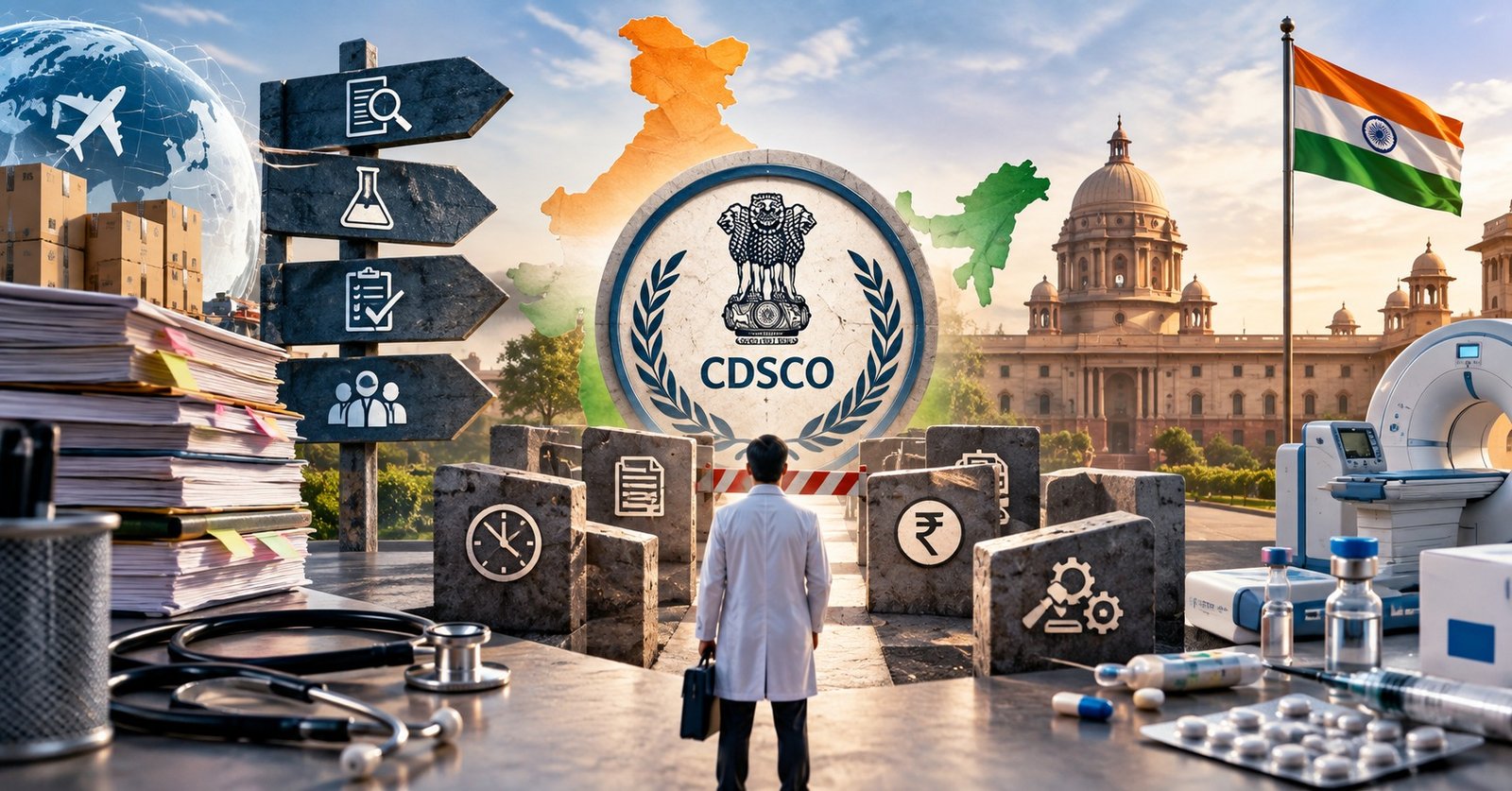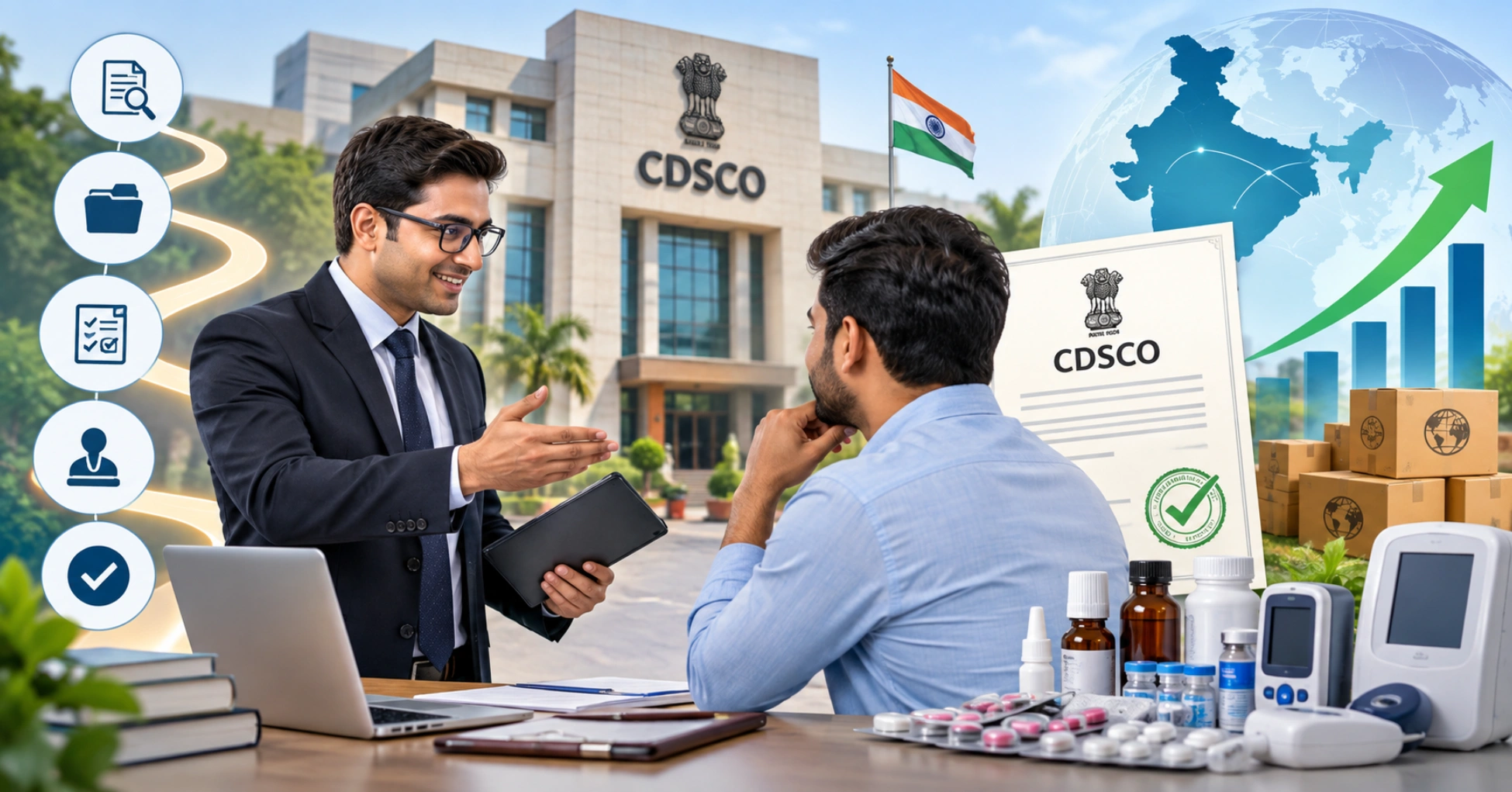
Businesses should choose a trusted CDSCO registration partner because India’s Medical Device Rules, 2017 involve strict classification, documentation, and SUGAM portal requirements where small errors cause months of delay. An experienced CDSCO regulatory consultant like TraccGlobal helps classify products correctly, prepares accurate technical files, manages CDSCO queries, and supports faster, compliant market entry.
For any company planning to manufacture, import, or sell a medical device, diagnostic kit, drug, or cosmetic product in India, CDSCO registration is not optional — it is the legal gateway to the Indian market. Yet the process is procedural, document-heavy, and unforgiving of small mistakes. This is exactly why manufacturers, importers, and startups across India and abroad look for a trusted CDSCO registration partner rather than attempting the SUGAM portal filing alone. This guide walks through what CDSCO registration actually involves, the mistakes that most commonly derail applications, and how TraccGlobal, a Gurugram-based regulatory consultancy, supports businesses from initial classification through post-approval compliance.
What Is CDSCO?
Definition
The Central Drugs Standard Control Organisation (CDSCO) is India’s national regulatory authority for drugs, medical devices, diagnostics, and cosmetics. It functions under the Directorate General of Health Services, within the Ministry of Health & Family Welfare, Government of India, and is responsible for approving new drugs, regulating clinical trials, setting standards, and licensing the import, manufacture, and sale of medical devices nationwide.
CDSCO’s authority over medical devices is exercised primarily through the Medical Device Rules, 2017, which brought India’s device regulation closer to global frameworks used by the US FDA and the European Union. Under these rules, devices are classified by risk — Class A (low risk) through Class D (high risk) — and each class carries different documentation, licensing, and review requirements. State licensing authorities and the CDSCO headquarters share responsibility depending on device class and licence type, with applications filed online through the SUGAM portal.
How CDSCO Fits Into India’s Healthcare Compliance Framework
CDSCO does not operate in isolation. It coordinates with state drug control departments for manufacturing licences, references international standards such as ISO 13485 for quality management systems, and — for many device categories — accepts prior approvals like CE Marking or US FDA clearance as supporting evidence, though never as a substitute for Indian registration. This layered structure is precisely where a CDSCO regulatory consultant earns their value: translating a global compliance file into the specific dossier CDSCO expects.
Why CDSCO Registration Is Important
Beyond legal necessity, registration functions as a market-access document. Hospitals, government tenders, distributors, and e-commerce marketplaces increasingly require valid CDSCO licence numbers before onboarding a product. Import consignments without a valid CDSCO import licence can be held at customs, leading to demurrage costs and shipment delays. For manufacturers, an unregistered facility cannot legally produce notified devices for the Indian market, regardless of the quality certifications it holds abroad.
Compliance Is Also a Risk Management Function
Companies frequently underestimate that CDSCO import license and manufacturing licence numbers are checked at multiple points — customs, state inspections, tender eligibility, and periodic audits. Treating registration as a one-time formality rather than an ongoing compliance obligation is one of the most common reasons businesses face disruption years after their initial approval.
Why Businesses Need a Trusted CDSCO Registration Partner
Handling CDSCO registration internally is possible in theory, but in practice it demands a combination of regulatory knowledge, document-drafting discipline, and familiarity with how CDSCO reviewers evaluate submissions — expertise that most manufacturing or business teams simply don’t maintain in-house. A trusted CDSCO registration partner brings this specialised knowledge as a service, rather than requiring a company to build it internally for what may be an occasional regulatory activity.
What “Trusted” Actually Means in Regulatory Consulting
In a YMYL (Your Money or Your Life) domain like healthcare regulation, “trust” is not a marketing adjective — it is measurable through transparency about process, realistic timelines, accurate documentation practices, and a consultant’s willingness to flag risk rather than promise guaranteed outcomes. A genuine CDSCO regulatory consultant explains the classification logic behind a recommendation instead of simply stating a conclusion, and is upfront that CDSCO — not the consultant — issues final approval.
Common Challenges in CDSCO Registration
Most delays in CDSCO filings trace back to a small set of recurring issues. Understanding them in advance is one of the most effective ways to keep an application moving.
| Common Challenge | Why It Happens | How TraccGlobal Addresses It |
|---|---|---|
| Incorrect device classification | Intended-use statements are ambiguous or self-assessed without regulatory reference | Formal classification review against Medical Device Rules, 2017 before filing begins |
| Incomplete technical documentation | Device Master File / Plant Master File built without CDSCO-specific templates | Structured DMF & PMF preparation aligned to CDSCO expectations |
| SUGAM portal errors | Portal formatting, file-size, and category rules are frequently updated | Dedicated SUGAM portal assistance and submission checks |
| Delayed query responses | Queries routed to technical teams unfamiliar with regulatory language | Query resolution managed directly by the regulatory team |
| No Indian clinical/performance data | Overseas trial data alone may not address India-specific queries | Guidance on bridging data and equivalence documentation strategy |
| Missed post-approval obligations | Companies treat approval as the finish line | Post-approval compliance and renewal tracking support |
Why TraccGlobal Stands Out
TraccGlobal is a Gurugram-based regulatory consultancy that has supported manufacturers, importers, startups, and global MedTech and pharma companies with India’s health-product regulations. Rather than operating as a broad compliance intermediary, the team positions itself as a deep specialist across CDSCO medical device registration, import and manufacturing licences, the Indian Authorised Agent (IAA) function, ISO 13485 alignment, and adjacent regulatory areas such as CE marking and US FDA pathways for products entering India from abroad.
A Single Team Across the Regulatory Lifecycle
One practical differentiator is continuity: the same team that manages classification and documentation also stays engaged through SUGAM submission, CDSCO query cycles, and — importantly — the post-approval period, including renewals and amendments. This reduces the handoff risk that occurs when classification, documentation, and filing are split across disconnected vendors.
TraccGlobal's End-to-End CDSCO Registration Process
An end-to-end CDSCO registration process covers every stage from initial product assessment to post-approval compliance, rather than only the act of filing on the SUGAM portal. Below is how TraccGlobal structures this workflow for a typical medical device or IVD client.
Initial Regulatory Consultation
Understanding the product, intended use, business model (manufacturer, importer, or agent), and target market to scope the regulatory pathway.
Product Classification
Formal risk-class determination (Class A–D) under the Medical Device Rules, 2017, including IVD-specific classification where relevant.
Documentation Review
Auditing existing technical, quality, and clinical documents against CDSCO’s expected dossier structure to identify gaps early.
Technical File Preparation
Compiling the technical documentation package — device description, labelling, risk analysis, and performance or clinical evidence.
DMF & PMF Support
Preparing the Device Master File (DMF) and Plant Master File (PMF) that describe the product and the manufacturing site’s quality system.
SUGAM Portal Assistance
Structuring and uploading the application on the SUGAM portal in the correct format and category, including fee-payment coordination.
CDSCO Submission
Formal filing of the complete application package to the relevant CDSCO office or state licensing authority.
Regulatory Communication
Acting as the point of contact for CDSCO correspondence throughout the review period.
Query Resolution
Drafting technical and regulatory responses to CDSCO queries, a stage where documentation quality directly affects turnaround.
Approval Support
Coordinating final steps once CDSCO indicates approval, including certificate issuance formalities.
Post-Approval Compliance
Supporting renewals, product amendments, manufacturing-site changes, and ongoing compliance obligations after the licence is granted.
Timelines for CDSCO review vary by device class, application completeness, and query cycles, and no consultant can ethically guarantee a fixed approval date. Businesses should plan for realistic, class-dependent timeframes rather than fixed promises.
| Stage | Primary Output | Typical Owner |
|---|---|---|
| Consultation & Classification | Regulatory pathway and device class confirmed | Consultant + Client |
| Documentation & DMF/PMF | Complete technical dossier | Consultant (client-supplied inputs) |
| SUGAM Filing | Submitted application with fee payment | Consultant |
| Review & Queries | Query responses, clarifications | Consultant + Client |
| Approval & Post-Approval | Licence issued; renewal/amendment tracking begins | Consultant |
Services Offered by TraccGlobal
| Service Area | What It Covers |
|---|---|
| CDSCO Medical Device Registration | Class A–D device registration, including simplified registration for eligible Class A devices |
| CDSCO Import License (MD-14/15) | Licensing support for importers bringing notified devices into India |
| CDSCO Manufacturing License | Support for domestic manufacturing facilities seeking device licences |
| Indian Authorised Agent (IAA) | Acting as, or helping appoint, the IAA required for overseas manufacturers |
| ISO 13485 QMS Support | Guidance aligning quality management systems with CDSCO expectations |
| CE Marking & US FDA Pathway Guidance | Supporting device registration across 20+ countries alongside Indian filing |
| Drug & Cosmetic Regulatory Support | CDSCO cosmetic import registration under Schedule S, and pharma consultancy including GMP and DPR preparation |
| FSSAI Licensing | Food product standards and labelling compliance under Schedule IV |
Industries Served
| Industry | Typical Regulatory Need |
|---|---|
| Medical device manufacturers (domestic) | Manufacturing licence, ISO 13485 alignment |
| Overseas MedTech companies | Indian Authorised Agent, import licence, device registration |
| In-vitro diagnostics (IVD) companies | IVD classification, performance-data strategy |
| Pharmaceutical exporters and manufacturers | Drug licensing, GMP compliance, DPR preparation |
| Cosmetics importers | Schedule S CDSCO cosmetic registration, INCI compliance |
| Food and nutraceutical businesses | FSSAI licensing and labelling compliance |
| Healthcare startups | End-to-end regulatory roadmap from concept to launch |
Medical Device Registration Expertise
| Device Class | Risk Level | Typical Requirement |
|---|---|---|
| Class A | Low risk | Registration; simplified route for non-sterile, non-measuring devices |
| Class B | Low-moderate risk | Manufacturing/import licence with technical documentation |
| Class C | Moderate-high risk | Detailed dossier, often with clinical/performance evidence |
| Class D | High risk | Comprehensive review, expert committee evaluation in many cases |
IVD devices — diagnostic kits for conditions such as blood typing, HIV, and hepatitis — follow this same risk-based framework, alongside non-notified diagnostic categories that carry their own compliance considerations. Correct classification at the outset materially reduces the risk of CDSCO queries later in the review.
If your device already holds CE Marking or US FDA clearance, treat that documentation as supporting evidence for your India dossier — not as a substitute for Indian-specific technical files or India-context performance data.
Drug Regulatory Support
Alongside device registration, TraccGlobal supports pharmaceutical companies with drug regulatory services spanning project setup, GMP certification support, Detailed Project Report (DPR) preparation, and PIC/S-aligned compliance guidance for manufacturers targeting export markets. This is particularly relevant for companies building or upgrading a manufacturing facility that must satisfy both CDSCO and international quality benchmarks simultaneously.
CDSCO Import License Assistance
| Aspect | Import License | Manufacturing License |
|---|---|---|
| Applies to | Devices made outside India | Devices made at an Indian facility |
| Key requirement | Indian Authorised Agent (IAA) | Site-specific Plant Master File |
| Payment mode | SUGAM/TR-6 Challan; ECS for overseas payments | SUGAM/TR-6 Challan |
| Common licensing forms | MD-14/15 (device-class dependent) | MD-5/MD-9 (device-class dependent) |
An Authorized Indian Agent must hold a valid wholesale or manufacturing licence and serves as CDSCO’s official point of contact for the overseas manufacturer. TraccGlobal can act as this agent or assist a company in appointing one, ensuring a clear regulatory accountability chain throughout the licence’s life.
Benefits of Working with TraccGlobal
- Single point of contact across classification, documentation, filing, and post-approval stages.
- Cross-category expertise spanning devices, IVDs, drugs, cosmetics, and food licensing under one team.
- India-specific dossier structuring for overseas companies already holding CE or US FDA approval.
- Ongoing compliance continuity, including renewals and amendments after initial approval.
- Indian Authorised Agent services for manufacturers without an Indian legal presence.
The core benefit of a trusted CDSCO registration partner is reduced regulatory risk — fewer classification errors, tighter documentation, and a managed communication channel with CDSCO throughout the review.
Success Factors Clients Should Look For
Client Preparation Checklist
| Preparation Item | Why It Matters |
|---|---|
| Clear intended-use statement for the product | Drives correct classification |
| Existing quality certifications (ISO 13485, CE, FDA) | Speeds documentation mapping |
| Manufacturing site details | Required for PMF preparation |
| Clinical or performance data, if available | Reduces likelihood of India-specific data queries |
| Decision on Indian Authorised Agent | Required before filing for overseas manufacturers |
Regulatory Mistakes vs. Best Practices
| Common Mistake | Recommended Best Practice |
|---|---|
| Self-classifying without regulatory reference | Have classification formally reviewed against Medical Device Rules, 2017 |
| Filing before documentation is complete | Complete DMF/PMF and technical file review before SUGAM submission |
| Treating approval as the end goal | Plan for renewal and amendment obligations from day one |
| Assuming CE/FDA approval covers India | Build an India-specific evidence and documentation strategy |
Illustrative Example
Consider a mid-sized Indian manufacturer of a Class IIa portable diagnostic device. By starting ISO 13485 implementation and clinical literature review at the same time as final product validation, the company completed Notified Body review in roughly seven months — close to the fastest end of the typical range for that device class — instead of the twelve-plus months seen when documentation work starts late.
This example is illustrative and does not represent an actual TraccGlobal client engagement.
Planning your CE Certification roadmap?
Speak with a regulatory affairs specialist about classification, documentation, and Notified Body selection.Frequently Asked Questions
Why should I hire a CDSCO registration consultant?
A CDSCO registration consultant helps correctly classify your product, prepares CDSCO-compliant documentation, manages SUGAM portal filing, and handles regulatory queries — reducing the risk of delays or rejection that often occur with self-managed applications.
What services does TraccGlobal provide?
TraccGlobal provides CDSCO medical device registration, import and manufacturing licence support, Indian Authorised Agent services, ISO 13485 guidance, drug and cosmetic regulatory support, and FSSAI licensing — covering most healthcare and consumer-health compliance needs under one team.
How long does the CDSCO registration process usually take?
Timelines vary by device class, application completeness, and CDSCO’s query cycle, so no fixed duration applies universally. Simpler Class A registrations generally move faster than Class C or D applications, which often involve more detailed technical review.
What documents are required for CDSCO registration?
Typical requirements include the Device Master File, Plant Master File, labelling and risk-analysis documentation, quality certifications like ISO 13485, and — depending on device class — clinical or performance data supporting safety and effectiveness claims.
Can TraccGlobal help with CDSCO import licenses?
Yes. TraccGlobal supports import licence applications (such as MD-14/15 filings), including acting as or helping appoint the Indian Authorised Agent that CDSCO requires for overseas manufacturers importing notified devices into India.
Does TraccGlobal support post-approval compliance?
Yes. TraccGlobal continues supporting clients after licence approval, including renewals, product amendments, manufacturing-site changes, and other ongoing regulatory obligations that arise over a product’s lifecycle in the Indian market.
Who needs CDSCO registration in India?
Any manufacturer, importer, or authorised agent dealing in notified medical devices, IVDs, or certain drugs and cosmetics needs CDSCO registration before selling, importing, or manufacturing the product for the Indian market.
Does having CE Marking or US FDA approval exempt a device from CDSCO registration?
No. CDSCO registration is a separate, mandatory requirement even for devices already CE-marked or FDA-cleared. Existing approvals can support the India dossier but do not replace the need for Indian regulatory filing.
What is the SUGAM portal used for?
The SUGAM portal is CDSCO’s official online system for submitting medical device, drug, and cosmetic licence applications, tracking application status, responding to queries, and managing fee payments for regulatory filings.
What is an Indian Authorised Agent and why is it required?
An Indian Authorised Agent is a locally licensed entity that represents an overseas manufacturer before CDSCO. It is a mandatory requirement for import licence applications and ensures a legally accountable point of contact within India.
Can TraccGlobal support both medical devices and pharmaceutical regulatory needs?
Yes. TraccGlobal supports medical device and IVD registration alongside drug regulatory services, cosmetic registration, and FSSAI food licensing, allowing companies with mixed product portfolios to manage related compliance needs through one consulting team.
Conclusion
TraccGlobal’s positioning as a specialist regulatory consultancy — spanning devices, diagnostics, drugs, cosmetics, and food licensing under one team — reflects the kind of continuity businesses look for when choosing a CDSCO regulatory consultant. Whether the need is a first-time CDSCO registration consultant India engagement, an import licence for an overseas manufacturer, or ongoing post-approval compliance, working with an experienced CDSCO licensing consultant allows businesses to focus on their product while the regulatory pathway is managed by specialists. For companies evaluating their options, TraccGlobal’s free initial consultation is a practical starting point to discuss classification and outline a regulatory roadmap before committing to a filing strategy.