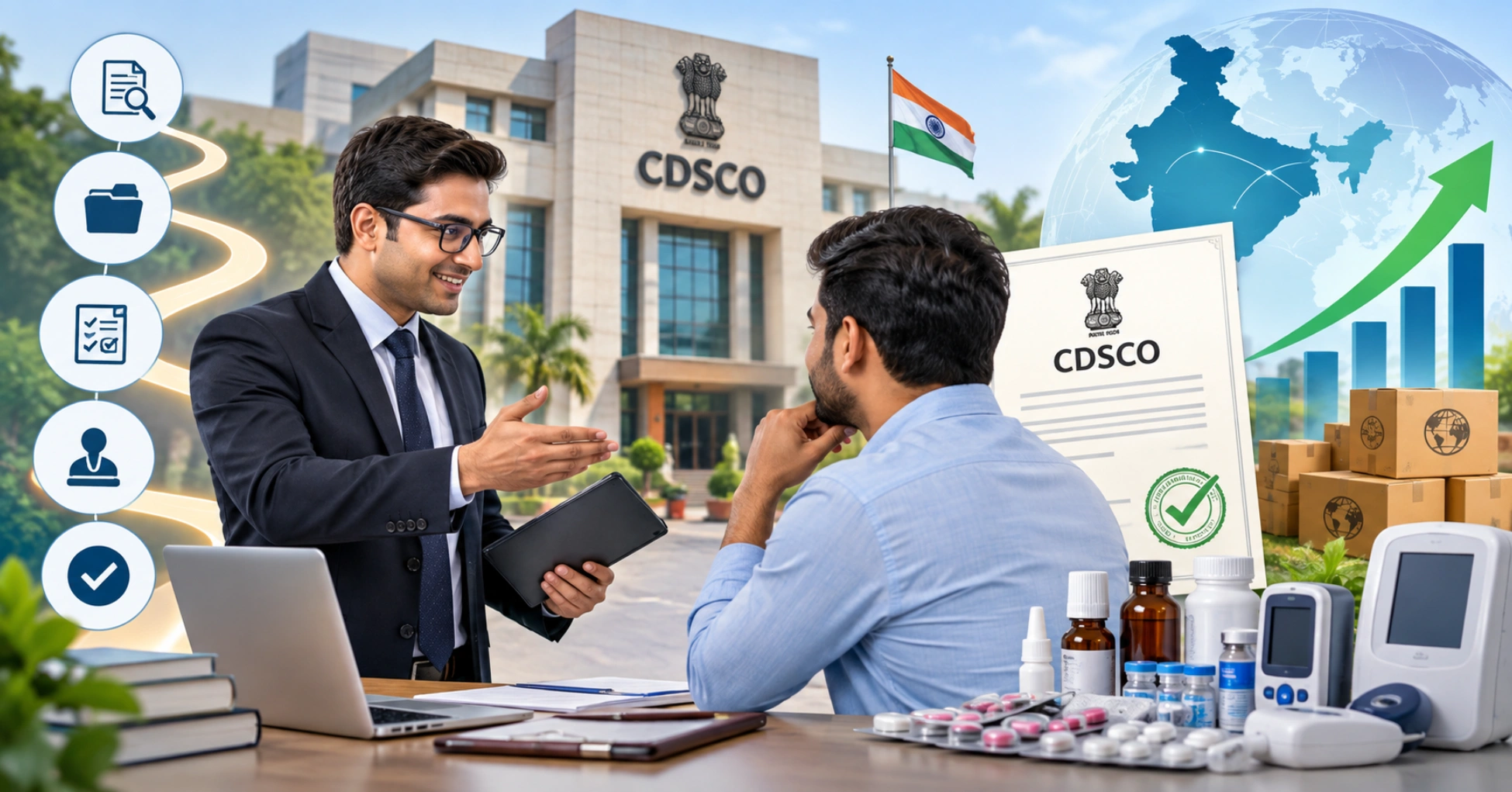
A CDSCO registration consultant helps a business work out which rules apply to its product, choose the correct registration or licensing pathway, prepare documentation, manage the SUGAM portal submission, and respond to regulatory queries. Exact scope depends on the product, its risk class, and the applicant’s role — manufacturer, importer, or overseas agent.
If you manufacture, import, or sell medical devices, drugs, diagnostics, or cosmetics in India, you’ve probably run into the term CDSCO more than once. For first-time importers, startups, and overseas manufacturers especially, the process feels confusing before it even starts. Which licence applies? Who submits the application? What documents does CDSCO actually want? This is where a CDSCO consultant in India earns their fee.
A consultant doesn’t replace your responsibility as a manufacturer or importer. What they bring is structure to a process that’s easy to get wrong on the first try — from checking whether your product needs registration at all, to organising a technical file, to handling the back-and-forth once your application is under review. Here’s what that support actually looks like.
What CDSCO is, and why it matters to your business
CDSCO stands for the Central Drugs Standard Control Organisation — India’s national regulator for drugs, medical devices, diagnostics, and cosmetics, operating under the Ministry of Health and Family Welfare. Its job is to make sure health-related products sold in India meet defined safety and quality standards before they reach the market.
For businesses, CDSCO isn’t an optional formality. If your product falls under a notified category, you generally cannot legally manufacture, import, or sell it in India without the applicable registration, licence, or approval. The two governing laws are the Drugs and Cosmetics Act, 1940 and the Medical Devices Rules, 2017, which specifically govern how devices and IVDs are classified and licensed.
When does a business actually need CDSCO registration?
Not every product needs the same approval, and not every business needs one at all. Broadly, CDSCO applies if you are:
- A manufacturer of medical devices, IVDs, drugs, or certain cosmetics based in India
- An importer bringing any of these categories into India from overseas
- An overseas manufacturer entering India, usually via an Authorised Indian Agent
- Setting up a new manufacturing facility for a regulated product
- Amending or renewing an existing licence after a product, site, or ownership change
Some products fall outside CDSCO’s notified list. Confirming applicability is usually the first thing a regulatory professional checks — applying for the wrong approval, or assuming exemption when there isn’t one, is a common and avoidable mistake.
How a CDSCO consultant actually helps a business
Depending on the product and your situation, support can include:
Applicability assessment
Checking whether your product needs CDSCO registration, and under which rule.
Classification support
Determining risk class for a device, or category for a drug or cosmetic.
Pathway identification
Clarifying registration vs. import licence vs. manufacturing licence.
Documentation
Organising technical files, manufacturing data, and certificates.
Application & forms
Preparing the correct SUGAM forms and compiling the submission.
Testing coordination
Liaising with accredited labs where test reports are required.
Regulatory communication
Acting as point of contact with the regulator during review.
Query response
Drafting clear, complete answers when CDSCO raises a deficiency.
Post-approval support
Helping with record-keeping and ongoing reporting duties.
Renewals & amendments
Updating a licence when product or business details change.
Worth being direct here: not every consultant offers every one of these, and not every business needs all of them. A Class A device manufacturer with a simple product has very different needs from an overseas drug manufacturer entering India for the first time. A good consultant tells you upfront which of this list actually applies to you.
Registration, approval, licensing, compliance — not the same thing
These four words get used loosely, but they mean different things.
| Term | What it actually means |
|---|---|
| Registration | Formally recording your product or facility with CDSCO — often the first step before further approval. |
| Approval | CDSCO’s decision that your application, product, or facility meets requirements. |
| Licence | The legal permission — a specific document, e.g. an import or manufacturing licence — authorising an activity. |
| Compliance | The ongoing duty to keep meeting requirements before, during, and after approval. |
Getting the regulatory pathway right
One of the earliest, most consequential decisions is figuring out which pathway your product falls under. Is it a medical device or a drug-device combination? A notified or non-notified diagnostic kit? A cosmetic needing import registration under the applicable schedule?
This matters because a wrong assumption early on can mean redoing significant work later. An overseas manufacturer entering India, for instance, typically needs a different approach — including appointing an Authorised Indian Agent — compared with an Indian manufacturer producing locally. Even within the same category, requirements shift based on classification.
Product classification and regulatory assessment
For medical devices and IVDs, the Medical Devices Rules, 2017 use a risk-based, four-tier classification system:
| Class | Risk level | What it generally means |
|---|---|---|
| Class A | Low risk | Simplest review path; still requires registration |
| Class B | Low–moderate risk | Somewhat more documentation scrutiny |
| Class C | Moderate–high risk | Often needs deeper technical review |
| Class D | High risk | Most rigorous review, often clinical evaluation data |
Getting this wrong at the start is one of the most common — and costly — mistakes. It can mean the wrong documentation, the wrong form, or a regulatory query that sends you back to the drawing board. A consultant’s classification assessment typically reviews your product’s intended use and risk profile against comparable devices already regulated under the Rules.
Documents, and the registration process itself
Businesses often expect a single, universal checklist for CDSCO registration requirements. In reality, the exact documents depend on your product category, classification, applicant type, and the specific rule your product falls under. That said, most applications draw from these broad categories:
- Product information — description, intended use, specifications
- Technical documentation — design details, risk analysis, standards compliance, labelling
- Manufacturing information — site details and process description
- Quality management system evidence — often referencing ISO 13485 for devices
- Testing reports — from accredited or notified labs, where applicable
- Certificates & authorisations — free sale certificates, GMP certificates, authorisation letters
- Applicant and agent details — including Authorised Indian Agent documents where relevant
A consultant’s real value here isn’t inventing new requirements — it’s making sure the documentation CDSCO actually asks for, for your specific product, is complete, consistent, and presented the way reviewers expect.
How the CDSCO registration process typically runs
Most applications go through the SUGAM online portal, the government’s digital system for licence and registration filings.
- Confirm applicability and classification
- Create the SUGAM account and prepare the application
- Compile and upload required technical and administrative documents
- Submit the application with applicable government fees
- Respond to any queries or deficiency notices raised during review
- Receive the registration certificate, approval, or licence
A consultant can support several of these steps — particularly documentation, portal submission, and query handling — but the application remains the legal responsibility of the applicant business.
What causes delays — and what registration really costs
| Common cause | Why it happens |
|---|---|
| Incomplete documentation | Missing certificates, gaps in the technical file, unsigned authorisation letters |
| Incorrect classification | Leads to the wrong form, pathway, or document set |
| Inconsistent manufacturer details | Addresses, product names, or site details that don’t match across documents |
| Weak technical documentation | Risk analysis or labelling that doesn’t fully address requirements |
| Mismatched testing evidence | Lab reports or standards that don’t align with the product’s class |
| Incomplete query responses | Answering only part of a regulatory query, triggering another round |
CDSCO registration fees: what actually drives the cost
There’s no single number for “the cost of CDSCO registration.” Total cost depends on the product category and classification, the number of products or variants covered, the application type (registration, licence, renewal, amendment), applicable government fees, testing costs where labs are required, documentation work, and any professional consulting charges. Because official fees are updated periodically and vary by product type and class, confirm current fee schedules directly with CDSCO or a regulatory professional at the time of application.
How long does CDSCO approval take?
Timelines depend on how complete the initial application is, the product’s risk class, whether queries are raised and how quickly they’re answered, testing or clinical evaluation requirements, and CDSCO’s processing workload at the time. No business or consultant can responsibly guarantee a fixed number of days or months — but complete documentation and prompt, thorough query responses reliably avoid the repeated delays that stretch timelines for others.
Why businesses use professional support — and how to choose it
Many businesses — first-time applicants, startups, and overseas companies without an India presence — work with a consultant because the process involves several moving parts at once: legal classification, technical documentation, a government portal, and ongoing regulator communication. A consultant brings pattern recognition: familiarity with what CDSCO typically expects, what triggers a query, and how to present a file so it’s easy for a reviewer to assess. That doesn’t remove the applicant’s legal responsibility for accuracy — but it does reduce the odds of the process going sideways from preventable mistakes.
Questions worth asking before you hire one
- Do they have relevant experience with your specific product category?
- Do they understand your product’s class, and can they explain why?
- Are they current on the Medical Devices Rules 2017, the Drugs and Cosmetics Act, and recent updates?
- Can they show documentation capability for similar products?
- Do they communicate clearly, rather than treating the process as a black box?
- Are they transparent about scope and cost — plainly stating what’s included?
- Do they think beyond approval day, to post-approval compliance?
- Can they explain the process in plain language?
A consultant who answers these clearly, without overselling guaranteed outcomes, is generally a safer partner than one promising the fastest approval in the market.
Why TraccGlobal can help
TraccGlobal is a Gurugram-based regulatory consultancy working with manufacturers, importers, startups, and overseas companies on CDSCO-related registration and licensing for medical devices, IVDs, cosmetics, and related categories. Its regulatory services cover CDSCO medical device registration, import and manufacturing licence applications, SUGAM portal submission support, and quality management system work aligned with standards such as ISO 13485 — alongside support for businesses acting through an Authorised Indian Agent when entering India from overseas.
Because the right support depends entirely on your product, its classification, and your business structure, the most useful starting point is a conversation about your specific product and goals rather than a generic package.
Not sure which pathway applies to your product?
Talk to TraccGlobal’s regulatory team about your product’s CDSCO registration or licensing requirements.
Frequently Asked Questions
What does a CDSCO consultant do?
Why do businesses hire a CDSCO registration consultant?
What documents are required for CDSCO registration?
How much does CDSCO registration cost in India?
How long does CDSCO registration take?
Does every medical device need CDSCO registration?
Can a consultant help with CDSCO licensing as well as registration?
What happens if CDSCO raises a query on an application?
What’s the difference between CDSCO registration and licensing?
How do I choose a reliable CDSCO consultant in India?
CDSCO regulation feels complicated mainly because requirements genuinely do change depending on your product, its classification, and your role. The most useful first step is a clear, honest assessment of what applies to your situation before you start filing anything.
Ready to work out your next regulatory step?
TraccGlobal’s team can walk through your product’s CDSCO requirements with you.
Company credentials
ISO 9001, ISO 27001 & ISO 45001 certified consultancy
Contact
info@traccglobal.com