traccglobal.com

What Is a Certificate of Pharmaceutical Product (CPP)?

Quick Answer
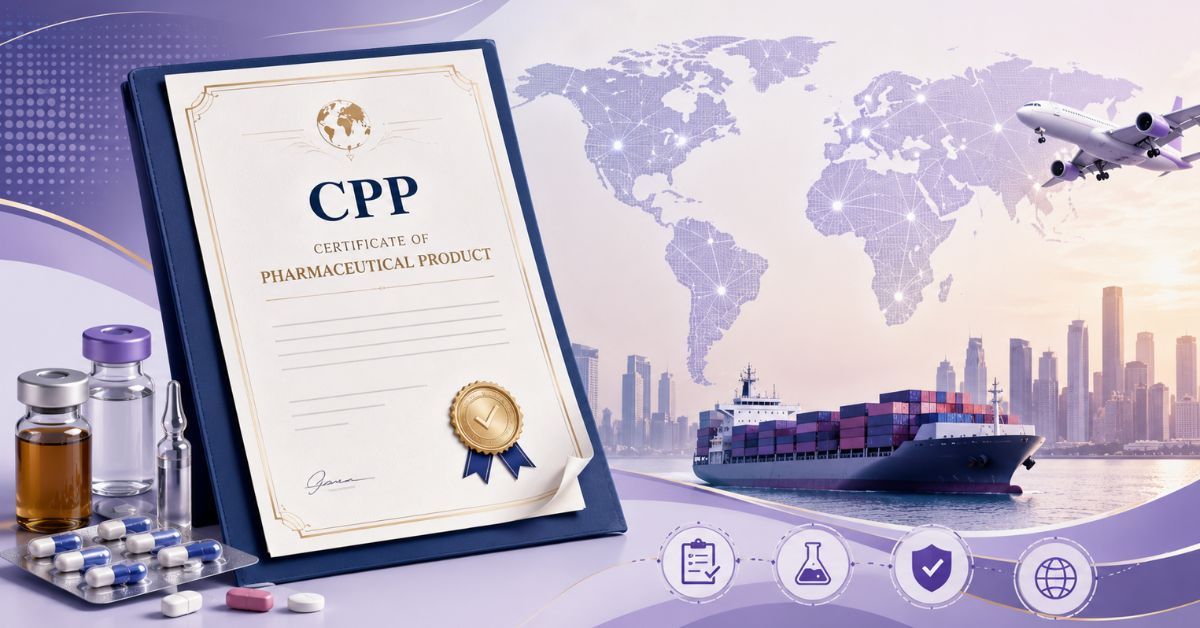
A CPP is a WHO-format certificate proving a medicine is authorized, GMP-compliant, and market-ready in its exporting country. Importing countries rely on it to approve drug registration and marketing authorization applications — making it essential for global market access.

What Is CPP in Pharma?

In pharma, CPP in pharma stands for Certificate of Pharmaceutical Product. It’s a regulatory document, not a marketing brochure — think of it as a “passport” for a medicine, telling another country’s drug authority that the product is real, approved, and safely manufactured.

The certificate of pharmaceutical product was created under the WHO Certification Scheme so smaller or newer regulatory authorities didn’t have to review every product from scratch. Instead, they could rely on the assessment already completed by a trusted exporting country.

Key Facts

Full name
Certificate of Pharmaceutical Product
Format
WHO-recommended — Annex 9, TRS No. 1033
Issued by
National/regional drug regulatory authority online)
Used for
Registration, authorization, renewals, tenders
Product scope
One product, one dosage form, one strength

CPP Full Form in Medical

The cpp full form in medical terminology is simply “Certificate of Pharmaceutical Product.” Some regulators, including the U.S. FDA, call it a COPP (Certificate of a Pharmaceutical Product) — the meaning is identical.

Whether you search for cpp full form in pharma or cpp meaning in a regulatory context, all roads lead back to this WHO-format certificate. Understanding this cpp meaning early helps regulatory teams avoid confusing it with unrelated export paperwork.

Why a Certificate of Pharmaceutical Product Is Important

Without a CPP, most national regulatory authorities will not open a drug registration file. That single fact — more than any keyword like cpp full form in pharma searches suggest — drives its real-world importance across the industry.

Why manufacturers and exporters rely on CPP

  • Speeds up drug registration by letting importing countries lean on prior regulatory review
  • Proves GMP compliance without a fresh plant inspection in every country
  • Supports drug export approval, tenders, and public procurement bids
  • Reduces duplicate paperwork across multiple international drug registration filings
  • Builds trust with distributors and government buyers

Who Issues a CPP?

A CPP is issued by the national regulatory authority of the exporting country — for example, the US FDA, the UK MHRA, Swissmedic, EMA member-state agencies, or India’s CDSCO.

Only a marketing authorization holder or their authorized agent can request it, and the authority will only certify a product it has already approved for sale (or, in limited cases, approved for export only).

Who can apply

Marketing Authorization Holder (MAH)

Manufacturer holding the license

Authorized regulatory affairs consultant

WHO Certification Scheme Explained

The WHO Certification Scheme on the quality of pharmaceutical products moving in international commerce is a voluntary international agreement, designed to give participating countries assurance about product quality — with the CPP as its primary document.

The scheme has been updated several times since it began, most recently through Annex 9 of WHO Technical Report Series No. 1033 (2021), which modernized the CPP format and clarified guidance for electronic certificates.

What the certifying authority confirms
  1. The product is authorized for sale in the exporting country (or the reason it isn’t)
  2. The manufacturing site is inspected and follows WHO GMP
  3. All submitted product information, including labelling, is currently authorized
A note on legalization

Requesting authorities are discouraged from adding legalization steps such as notarization, embassy legalization, or apostillation, since these can cause unnecessary delays. Even so, many importing countries still ask for it in practice — always confirm local requirements before you submit.

Electronic CPP (eCPP)

Several regulators, including the US FDA, now issue certificates electronically with a QR code for instant verification, and WHO has encouraged this shift toward secure e-signatures as a practical alternative to paper.

When Is a CPP Required?

A CPP is typically required when:

  • Filing a new drug registration or marketing authorization application abroad
  • Renewing, varying, or extending an existing product license
  • Responding to a government or international tender/procurement bid
  • Demonstrating pharmaceutical compliance for customs or import screening
  • Supporting bioequivalence or stability data submissions in a new market

Is CPP mandatory for all exports? Not universally — it depends on the importing country’s regulation. However, most global drug registration authorities across Asia, Africa, Latin America, and the Middle East request it as a default requirement.

Documents Required for CPP

CPP documentation checklist
  • Product marketing authorization / license details
  • Complete formula, including all excipients
  • Approved product information (professional & patient leaflets)
  • Manufacturing site GMP inspection status
  • Application form as prescribed by the national authority
  • Authorization letter (if a consultant or agent files on your behalf)
  • Payment of applicable regulatory fees

Step-by-Step CPP Application Process

1

Eligibility verification

Confirm the product holds valid domestic marketing authorization.

2

Document preparation

Compile the checklist above; ensure formula and labelling match the current license exactly.

3

Authority submission

File the application with the national regulatory authority using their prescribed CPP form.

4

Regulatory review

The authority verifies the product’s licensing status and manufacturing GMP compliance.

5

Site/GMP confirmation

If needed, the authority checks recent inspection records for the manufacturing plant.

6

Approval decision

The authority signs off once all information is verified as accurate and current.

7

Certificate issuance

The CPP is stamped, dated, and issued — paper or electronic (eCPP).

8

Transmission to importing country

The applicant or agent forwards the CPP to the importing country’s authority.

9

Validity monitoring

Track expiry and renewal dates for every export market you serve.

10

Renewal filing

Reapply before expiry to avoid registration gaps.

CPP vs Certificate of Free Sale

Many exporters confuse a CPP with a Certificate of Free Sale (CFS). They serve different purposes.

FeatureCPPCertificate of Free Sale
Confirms GMP compliance online) YesNo
Confirms marketing authorization online) YesSometimes
Confirms product is sold domestically online) YesYes
WHO-recognized format online) YesNo
Common use online) Drug registration, tendersGeneral export, customs
Regulatory depthDetailedBasic

Quick takeaway: A CFS simply says a product is legally sold; a CPP goes further, confirming GMP status and full regulatory approval — which is why most drug authorities specifically ask for a CPP, not a CFS.

Common Challenges During CPP Approval

Mismatched formula or labelling details between the license and the CPP application Delays from unnecessary legalization or embassy authentication requests Confusion over country-specific CPP formats and validity rules Missing GMP inspection records for older manufacturing sites Lack of a clear internal process for tracking multiple country requests

Case Study

Expert tip

Maintain a master regulatory file with your current marketing authorization, GMP certificates, and product information — so a CPP application never starts from zero.

CPP Validity and Renewal

1–2 yrs

Typical CPP validity period

6–12 mo

"Recently issued" window some regulators expect

60–90 d

Recommended lead time before renewal filing

Most CPPs remain valid for 1 to 2 years, though this varies by issuing authority and by the importing country’s own rules. Some importing regulators also require the CPP to be recently issued at the time of submission, regardless of its stated expiry.

Renewal best practices
  • Track expiry dates for every export market separately
  • Start renewal filings at least 60–90 days before expiry
  • Re-verify that product information still matches your current license before reapplying

Expert Tips for Faster CPP Approval

  1. File for your CPP immediately after domestic approval — don’t wait for a buyer to ask
  2. Keep your regulatory dossier updated so no last-minute document gaps appear
  3. Clarify legalization requirements with the importing country before you submit
  4. Use experienced regulatory affairs consulting support for multi-country filings
  5. Track every certificate’s validity in a simple regulatory calendar

Need help with a CPP application?

Navigating CPP documentation across multiple drug regulatory requirements can be time-consuming, especially when every export market has its own expectations. Traccglobal supports pharmaceutical manufacturers and marketing authorization holders with CPP documentation, pharmaceutical registrations, and international drug registration strategy — from a first-time export filing to a full global market access roadmap.

Frequently Asked Questions

Q1. What is CPP full form in medical?

CPP stands for Certificate of Pharmaceutical Product. It’s a WHO-format certificate confirming a medicine’s regulatory approval and GMP compliance in its country of origin, used mainly for international drug registration.

CPP in pharma is an official regulatory document proving a specific drug product is authorized for sale and manufactured under GMP. Importing countries use it to support marketing authorization decisions.

The national or regional drug regulatory authority of the exporting country issues the CPP — for example, the FDA, MHRA, Swissmedic, or CDSCO — upon request from the marketing authorization holder.

It depends on the importing country. Many national authorities, especially across Asia, Africa, and Latin America, require a CPP before accepting a drug registration application.

Timelines vary widely by country and are not centrally fixed by WHO. Building in extra time and avoiding documentation gaps is the best way to prevent delays.

Typically: marketing authorization details, complete formula, approved product information, GMP inspection status, and a completed application form for the issuing authority.

Most CPPs are valid for 1–2 years, though the issuing authority and the importing country’s own acceptance rules both affect how long a certificate stays usable.

A CPP confirms GMP compliance and full marketing authorization; a Certificate of Free Sale only confirms the product is legally sold domestically, without the same regulatory depth.

Yes. Several regulators now issue electronic CPPs (eCPPs) with verification features like QR codes, and WHO has supported this as a valid alternative to paper certificates.

WHO discourages added legalization steps since they can delay certificates, but some importing countries still request notarization or embassy authentication in practice — always check first.


Facebook
Twitter
Pinterest
LinkedIn
Picture of Rajesh

Rajesh

Auther & Publisher

All Posts

Leave a Reply

Your email address will not be published. Required fields are marked *

Latest Post

How to Apply for BIS Certification for Medical Devices

Table of Contents Our Services Regulatory Services Quality Management System Turnkey Project Services Subject Matter Expert Product Services Design & Development Design And Software Connect With Us BIS Certification for Medical Devices is a mandatory or scheme-dependent approval issued by the Bureau of Indian Standards confirming that a medical device meets applicable Indian Standards (IS) for safety and performance. Manufacturers apply via BIS registration online, submit test reports from BIS-recognized labs, and — for ISI Mark products — pass a factory audit. Certification is typically valid for two years. BIS certification for medical device approval confirms that a product meets India’s official safety and quality benchmarks before it can be manufactured, imported, or sold in the country. Manufacturers apply through the BIS online portal, get their product tested at a recognized lab, submit documentation, and — depending on the scheme — undergo a factory inspection. Many manufacturers assume international approvals are enough to sell in India. They aren’t. If your device falls under a notified Indian Standard, BIS registration for medical device categories is a legal requirement, not a suggestion — businesses that skip this step often discover the problem only when a shipment is held at customs, a hospital tender rejects their product, or an e-commerce listing gets pulled down. This guide covers what BIS Certification actually requires, who needs it, exact documents and steps, realistic costs and timelines, and the mistakes that get applications rejected — so you can plan your Medical Device BIS Registration with confidence. What Is BIS Certification for Medical Devices? BIS Certification is the conformity mark issued by the Bureau of Indian Standards confirming a product meets a specific Indian Standard (IS). For medical devices, this traces to Rule 7 of the Medical Device Rules, 2017, requiring devices to conform to BIS or pharmacopeial standards where applicable. In February 2022, the government notified a detailed list linking specific medical devices to their corresponding BIS standards, giving manufacturers a clear roadmap instead of ambiguity. Review timelines by device class Scheme Common Name Key Feature Scheme I ISI Mark Certification Factory inspection + sample testing Scheme II Compulsory Registration Scheme (BIS CRS) Self-declaration + third-party lab testing, no factory audit FMCS Foreign Manufacturers Certification Scheme ISI Mark route for overseas manufacturers Key Facts Legal basis: Medical Device Rules, 2017 (Rule 7) · Governing regulation for CRS: BIS (Conformity Assessment) Regulations, 2018 · Typical certificate validity: 2 years, renewable × Why BIS Certification Is Important Legal protection: Selling notified devices without valid certification can lead to seizure, penalties, or prosecution under the BIS Act, 2016. Market access: Hospitals, distributors, and e-commerce platforms increasingly demand proof of BIS Approval before onboarding a product. Customs clearance: Imported devices without registration are routinely held or rejected at Indian ports. Trust signal: A BIS Certificate Online builds credibility with buyers who equate the ISI or CRS mark with tested, safe quality. Common Misconception Even a CE-marked or FDA-cleared device needs separate BIS Certification if it falls under a notified Indian Standard. International approval does not substitute Indian regulatory compliance. × Who Needs BIS Certification? You likely need BIS certification for medical device approval if you are: A domestic manufacturer of a device listed under the 2022 BIS standards notification Mandatory An importer or distributor bringing a notified device into India Mandatory A foreign manufacturer exporting notified devices to Indian buyers or hospitals Mandatory An OEM supplying components used in finished notified devices Mandatory A startup with a device outside any notified standard, seeking a market trust signal Voluntary Certification applies only where a device category has a corresponding notified Indian Standard — the mandatory vs. voluntary distinction manufacturers frequently overlook. Eligibility Criteria for BIS Registration 1 The device must fall under a category with a notified Indian Standard (IS). 2 The manufacturing unit (Indian or overseas) must have traceable quality control records. 3 Foreign manufacturers must appoint an Authorized Indian Representative (AIR) based in India. 4 Product samples must be testable at a BIS-recognized laboratory. 5 A functioning Quality Management System is recommended — ISO 13485 certification strongly supports the application. Documents Required for BIS Registration Use this checklist before starting your BIS registration online application: Company incorporation and business registration proof Product technical specification sheet Applicable Indian Standard (IS) number identified for the device Test report from a BIS-recognized laboratory (not older than 90 days at submission) Manufacturing site address and process details Authorized Indian Representative appointment letter (foreign manufacturers) Quality management documentation (ISO 13485 certificate, if available) Labeling and packaging artwork showing intended mark placement CDSCO registration details, where applicable Step-by-Step BIS Registration Process Illustrative Example — educational only, not an actual client story A manufacturer of digital thermometers preparing to launch in India confirms their product falls under a notified IS number, gets it tested at a recognized lab, compiles documents, and files through the BIS portal. After sample testing clears and paperwork is verified, they receive their registration number and begin using the mark on packaging — all within roughly ten weeks. × Product Classification — Identify whether your device is listed under BIS-notified standards and determine the correct IS number. Standard Identification — Confirm Scheme I (ISI Mark) or Scheme II (CRS Registration) applies. Laboratory Testing — Send samples to a BIS-recognized lab for conformity testing. Document Preparation — Compile the checklist above with current test reports and technical files. BIS Portal Registration — Create an account and prepare your application profile. Application Filing — Submit with test reports, product details, and manufacturer information. Factory Inspection (where applicable) — Required for ISI Mark (Scheme I); generally not required for CRS. Certification Approval — BIS issues the registration or license number after verification. Surveillance — BIS may pull independent samples periodically to verify ongoing conformity. Renewal — Valid for two years; renew before expiry to avoid a compliance gap. Post-Certification Compliance — Maintain quality consistency and update BIS on manufacturing changes. Compliance Tip Keep a compliance calendar tracking your certificate’s renewal date — a lapsed BIS license for medical devices can block sales just as effectively as never having one. × BIS Registration Online Process The BIS portal centralizes most of the workflow: Applicant registration and

Read More »

6 Steps for Saudi Arabia Medical Device Registration

Table of Contents Our Services Regulatory Services Quality Management System Turnkey Project Services Subject Matter Expert Product Services Design & Development Design And Software Connect With Us Medical Device Registration in Saudi Arabia follows six core steps: classify your device, appoint a Saudi Authorized Representative, prepare your technical file, submit through the GHAD portal, respond to SFDA review queries, and receive your MDMA certificate. The full process typically takes 3–6 months depending on device class. Saudi Arabia is now the largest medical device market in the Middle East, driven by Vision 2030 healthcare spending and rapid hospital expansion. That growth comes with strict rules — here’s exactly how compliance works. What Is Medical Device Registration in Saudi Arabia? Medical Device Registration in Saudi Arabia is the legal process of obtaining a Medical Device Marketing Authorization (MDMA) from the Saudi Food and Drug Authority (SFDA) before a device can be imported, marketed, sold, or used anywhere in the Kingdom — hospitals, clinics, pharmacies, or online platforms. SFDA is the sole regulatory authority for medical devices and IVDs in the country, and a member of the International Medical Device Regulators Forum (IMDRF). Once approved, your device is listed on the Medical Devices National Registry (MDNR), and the MDMA certificate is issued in both Arabic and English. Without it, no distributor, hospital, or warehouse in Saudi Arabia may hold or sell your product — there are no exceptions for foreign manufacturers. 2022 Regulatory Shift 2022 Regulatory Shift Before 2022, manufacturers with CE Marking or FDA clearance could use the faster GHTF route (MDMA1). That route — and the low-risk MDNR listing shortcut — was cancelled. Every device now follows the MDMA2 Saudi Route, requiring a complete, Saudi-specific technical file regardless of prior approvals. × Why SFDA Registration Matters Saudi FDA Medical Device Registration isn’t a formality — it’s your legal license to operate in the Kingdom. Skipping it, or getting it wrong, carries real consequences. No government tenders without it. Public hospital procurement and Ministry of Health contracts require a valid MDMA. Non-compliance risks seizure. Devices without MDMA can be confiscated, with import bans and fines to follow. Gateway to the GCC. SFDA approval is widely recognized across the Gulf — UAE, Bahrain, Kuwait, Oman, Qatar — often speeding up regional expansion. Builds long-term trust. A valid SFDA Medical Device Registration signals your quality system and documentation meet international standards. Quick Takeaway SFDA registration is the single gateway between your device and the Saudi healthcare market — and increasingly, the wider GCC region. × Medical Device Classification in Saudi Arabia Before anything else, your device must be classified correctly. SFDA uses a risk-based system built on GHTF Classification principles and 22 classification rules for medical devices (7 for IVDs) — closely mirroring the EU MDR framework. Low risk Bandages, non-invasive supports Streamlined document review Low–moderate risk Blood pressure monitors, syringes Standard technical review Moderate–high risk Infusion pumps, ventilators Detailed technical + clinical review High risk Pacemakers, implantable devices Full file + on-site GMP inspection Expert Tip If your device already carries a CE classification, the same class often applies under SFDA — but you must still formally confirm and document this within your MDMA application. Never assume it transfers automatically. Getting SFDA Classification wrong is one of the most common causes of rejection. × 6 Steps for Saudi Arabia Medical Device Registration The complete Medical Device Registration Process used by manufacturers, importers, and consultants entering the Saudi market today. Classify Your Device Correctly Determine your device’s risk class (A, B, C, or D). This decision drives every requirement that follows — documentation depth, review timeline, fees, and whether an on-site inspection is required. Build your regulatory strategy around this early; reclassifying mid-process can restart the clock. Appoint a Saudi Authorized Representative (AR) Foreign manufacturers cannot submit an MDMA application directly. You need an in-country Authorized Representative Saudi Arabia — a Saudi-resident entity holding a valid Authorized Representative License through the GHAD system. Your AR submits and signs the application, handles adverse event reporting, manages post-market surveillance, and appears on your labeling and IFU. Prepare Your Technical File and Documentation This is where most delays happen. Your Technical File Assessment (TFA) must include device description, design and manufacturing details, risk management documentation, Arabic labeling for patient-facing devices, and evidence of Medical Device Quality Management — typically ISO 13485 certification. SFDA reviews the dossier independently; it does not simply accept foreign approvals. Submit Through the SFDA GHAD Portal Your AR submits the complete Medical Device Technical File electronically through SFDA’s Unified Electronic System (GHAD), with fees paid at submission. Devices sharing the same manufacturer, intended use, class, and design can sometimes be grouped under one application to save time and cost. Respond to SFDA Review and Queries Reviewers check completeness, technical accuracy, and compliance with Essential Principles of Safety and Performance. Class C and D devices may need an on-site GMP inspection. Queries are normal — a fast, thorough response is the biggest factor in avoiding a second review round. Receive Your MDMA Certificate and Enter the Market Once satisfied, SFDA issues the Medical Device Marketing Authorization (MDMA) and lists your device in the MDNR. Validity periods are commonly cited around 3 years — always confirm current terms with SFDA at time of application. Post-market obligations begin immediately. Documents Required for SFDA Registration Use this checklist to prepare your Medical Device Documentation before submission. Device description, specifications, and intended use statement Risk management file and clinical evaluation data ISO 13485 quality management certificate Labeling and Instructions for Use (Arabic where required) Electrical safety / EMC test reports (IEC 60601 family, for active devices) Sterilization validation and shelf-life data, where applicable Declaration of Conformity or equivalent international approval evidence Authorized Representative agreement and licensing documents Post-market surveillance and vigilance procedures Regulatory Alert Expired CE/FDA/ISO certificates, or certificates not properly attested, are among the top reasons SFDA applications stall or get rejected. × Common Challenges During Registration Wrong classification — applying under a lower class than the device actually qualifies for Incomplete Arabic translation of labels and IFUs Weak technical files that don’t match SFDA’s

Read More »

Top 7 Pharmaceutical Consulting Companies in India 2026

Table of Contents Our Services Regulatory Services Quality Management System Turnkey Project Services Subject Matter Expert Product Services Design & Development Design And Software Connect With Us Pharmaceutical consulting companies in India help pharmaceutical manufacturers, biotech firms, and healthcare organizations manage regulatory approvals, GMP compliance, quality systems, and global market entry requirements. These consulting firms support CDSCO registrations, Schedule M compliance, WHO GMP certification, pharmacovigilance, and international regulatory submissions. By providing specialized regulatory expertise, they help businesses reduce approval delays, strengthen compliance, and accelerate access to domestic and international markets. Leading firms such as Traccglobal offer end-to-end pharmaceutical consulting services tailored to the evolving regulatory landscape in 2026. India is one of the world’s leading pharmaceutical hubs, ranking among the largest producers of generic medicines and supplying a significant share of global vaccine demand. As Indian pharmaceutical companies expand into regulated markets, they must comply with increasingly complex requirements from authorities such as CDSCO, US FDA, EMA, WHO, MHRA, and PMDA. Navigating these regulations requires specialized expertise, making pharmaceutical consulting companies an essential partner for manufacturers seeking sustainable growth, faster approvals, and stronger compliance outcomes. In 2026, regulatory expectations continue to evolve with stricter GMP standards, enhanced data integrity requirements, and growing global scrutiny of pharmaceutical supply chains. The right pharma consultancy can help businesses reduce regulatory risks, streamline approval processes, and successfully enter domestic and international markets. This guide compares the top 7 pharmaceutical consulting companies in India for 2026, evaluating each firm based on regulatory expertise, service capabilities, industry experience, market reputation, and client value. Whether you are a pharmaceutical startup launching your first product, an API manufacturer expanding exports, or an established company preparing for global regulatory approvals, this list will help you identify the consulting partner best suited to your business goals. What Do Pharmaceutical Consulting Companies Do? Pharmaceutical consulting companies help manufacturers, biotechnology firms, healthcare organizations, and life sciences businesses navigate complex regulatory, quality, and compliance requirements throughout the product lifecycle. From product development and regulatory approvals to GMP compliance and global market expansion, these firms provide the specialized expertise needed to meet evolving industry standards and regulatory expectations. In 2026, pharmaceutical consulting firms play a critical role in helping companies adapt to revised Schedule M requirements, strengthen quality systems, prepare for regulatory inspections, and accelerate access to both domestic and international markets. By partnering with experienced consultants, organizations can reduce compliance risks, improve operational efficiency, and focus on core business activities such as research, manufacturing, and commercialization. Core Services Offered by Pharmaceutical Consulting Firms Regulatory Affairs Services Regulatory affairs remain one of the most important functions provided by pharmaceutical consulting companies. These services help organizations navigate approval pathways and maintain compliance with national and international regulations. CDSCO drug registration and product approvals New Drug Applications (NDA), Abbreviated New Drug Applications (ANDA), and Fixed Dose Combination (FDC) submissions Drug Master File (DMF) preparation and regulatory documentation Clinical Trial Applications (CTA) and regulatory support for clinical studies Import and export licensing assistance Regulatory strategy development for new and existing products Orphan drug designation and special pathway support GMP and Quality Compliance As regulatory authorities continue to raise manufacturing standards, quality and compliance consulting has become essential for pharmaceutical businesses. Schedule M GMP compliance and gap assessments WHO GMP certification preparation and inspection readiness US FDA 21 CFR Part 210/211 compliance support EU GMP compliance under EMA requirements Mock inspections and regulatory audit preparation Corrective and Preventive Action (CAPA) management Quality Management System (QMS) implementation and SOP development International Regulatory Support For companies targeting global markets, pharmaceutical consulting firms provide strategic guidance on country-specific regulatory requirements and submission processes. US FDA submissions, including ANDA, NDA, and DSCSA compliance EMA regulatory submissions and market authorization support WHO Prequalification (PQ) for APIs and finished formulations UK MHRA, Health Canada, and TGA registration support ACTD submissions for ASEAN countries Multi-country regulatory planning and lifecycle management Pharmacovigilance and Post-Market Compliance Maintaining compliance after product approval is equally important. Consultants help establish systems that ensure ongoing patient safety and regulatory adherence. Pharmacovigilance system development and PVPI support PSUR and PBRER preparation Signal detection and risk management planning Adverse Drug Reaction (ADR) reporting systems Safety monitoring and regulatory reporting Clinical and Scientific Support Many pharmaceutical consulting firms also assist with clinical and scientific activities that support product registration and lifecycle management. Bioequivalence (BE) and Bioavailability (BA) study support Clinical evaluation and scientific literature reviews Stability study planning and protocol development CTD dossier preparation and technical writing Clinical and regulatory documentation support Training and Capability Development To help organizations build long-term regulatory competence, leading pharma consultancy firms offer structured training programs and knowledge transfer initiatives. Regulatory affairs training for pharmaceutical teams GMP awareness and inspection-readiness workshops Data integrity and compliance training eCTD publishing and document management training Quality culture and continuous improvement programs Pharmaceutical consulting companies serve as strategic partners for regulatory compliance, quality assurance, market access, and business growth. Their expertise helps pharmaceutical organizations navigate evolving regulations, reduce approval timelines, strengthen compliance frameworks, and compete effectively in global healthcare markets. × Why Pharma Consulting Companies Are Essential for Indian Pharma Businesses in 2026 India’s pharmaceutical industry is evolving rapidly, driven by stricter regulatory oversight, updated manufacturing standards, and growing global market opportunities. Regulatory authorities such as CDSCO, WHO, US FDA, EMA, and MHRA continue to raise compliance expectations, making it increasingly difficult for pharmaceutical companies to manage every requirement internally. As a result, pharmaceutical consulting companies have become strategic partners for manufacturers looking to maintain compliance, accelerate approvals, and expand into regulated markets. Here are the key reasons why their expertise is more valuable than ever in 2026. 1. Revised Schedule M Compliance Has Raised the Bar The implementation of India’s revised Schedule M has significantly changed GMP expectations for pharmaceutical manufacturers. The updated framework emphasizes quality systems, risk management, validation practices, documentation controls, and continuous improvement. Many small and mid-sized manufacturers are finding it challenging to align existing operations with these new requirements. Experienced pharma consultancy firms help organizations identify compliance

Read More »

Top 10 Medical Device Consulting Companies in India

Table of Contents Our Services Regulatory Services Quality Management System Turnkey Project Services Subject Matter Expert Product Services Design & Development Design And Software Connect With Us Medical device consulting companies in India help manufacturers and healthcare businesses manage CDSCO approvals, ISO 13485 certification, CE marking, US FDA compliance, and regulatory documentation. Leading firms like Traccglobal provide end-to-end support for device registration, quality management systems (QMS), audit preparation, MDR 2017 compliance, and global market entry. These consultants help companies reduce regulatory delays, improve compliance, and launch medical devices faster in Indian and international markets. India’s medical device industry is growing rapidly, but so are regulatory requirements. From CDSCO approvals and ISO 13485 certification to CE marking and MDR 2017 compliance, medical device manufacturers now need expert regulatory support to launch products successfully in India and global markets. This is where experienced medical device consulting companies in India play a critical role. Leading firms like Traccglobal help manufacturers, healthcare startups, diagnostics companies, and exporters manage regulatory documentation, quality management systems (QMS), audit readiness, and market-entry approvals efficiently. With the right consulting partner, businesses can reduce compliance risks, avoid costly delays, and speed up product approvals. In this guide, we compare the top medical device consulting companies in India based on regulatory expertise, service quality, industry experience, and global compliance support to help you choose the right partner for your business. What Do Medical Device Consulting Companies Do? Medical device consulting companies in India help manufacturers, healthcare startups, and pharma businesses manage complex regulatory and compliance requirements. They act as regulatory and quality management partners, helping companies secure approvals, maintain compliance, and launch products smoothly in Indian and international markets. These consultants typically support: CDSCO medical device registration and licensing ISO 13485 certification and audit preparation CE marking and EU MDR compliance US FDA regulatory support and 510(k) submissions Quality Management System (QMS) development Risk management and ISO 14971 implementation BIS certification for medical devices Technical dossier and regulatory documentation preparation Mock audits and compliance training Multi-country regulatory strategy and market-entry planning By working with experienced medical device regulatory consultants in India, companies can reduce approval delays, avoid compliance errors, and improve their chances of faster market entry. Why Are Medical Device Consultants Important in India? India’s medical device industry is becoming more regulated every year. With the introduction of MDR 2017, stricter CDSCO compliance requirements, and growing international quality standards, manufacturers now need expert regulatory guidance to launch products successfully. This is why medical device regulatory consultants in India have become essential for medical device companies, exporters, and healthcare startups. 1. CDSCO Approvals Are Complex Medical device approvals in India require detailed technical documentation, testing reports, device classification, and regulatory submissions through the CDSCO SUGAM portal. Experienced consultants help reduce documentation errors, manage queries efficiently, and improve approval timelines. 2. ISO 13485 Certification Supports Global Expansion Manufacturers planning to export medical devices often need ISO 13485 certification and a compliant Quality Management System (QMS). Regulatory consultants help companies implement quality standards, prepare audit-ready documentation, and maintain long-term compliance. 3. Compliance Mistakes Can Be Costly Incorrect device classification, incomplete dossiers, or non-compliant labelling can lead to CDSCO rejection, audit failures, product recalls, or delayed market entry. Medical device consulting companies help minimise these risks through proper regulatory planning and documentation support. 4. Regulations Change Frequently CDSCO guidelines, EU MDR requirements, and ISO standards for medical devices continue to evolve. Regulatory consultants stay updated with the latest compliance changes and help businesses adapt quickly. 5. Faster Product Launch and Market Entry With expert regulatory support, companies can streamline approvals, avoid unnecessary delays, and bring products to market faster. This gives manufacturers a strong competitive advantage in both Indian and international medical device markets. Quick Takeaway Working with experienced medical device regulatory consultants in India helps companies improve compliance, reduce approval delays, and build a stronger foundation for long-term business growth. How to Choose the Right Medical Device Consulting Company in India Choosing the right medical device consulting company in India is important for faster approvals, better compliance, and smooth market entry. Since regulatory requirements are becoming stricter under MDR 2017 and global standards, businesses should carefully evaluate consulting firms before making a decision. 1. Check Regulatory Expertise A reliable consulting company should have experience with CDSCO registration, ISO 13485 certification, CE marking, and US FDA compliance. Ask about their previous projects, approval success rate, and experience handling different medical device categories. 2. Look for Industry-Specific Experience Different medical devices require different regulatory approaches. Some consultants specialise in IVD devices, while others focus on surgical instruments, diagnostic equipment, digital health products, or combination devices. Choose a firm that understands your industry segment. 3. Evaluate Team Qualifications Experienced consultants often come from regulatory affairs, biomedical engineering, quality assurance, or clinical backgrounds. Teams with former CDSCO auditors or ISO compliance experts can provide stronger regulatory guidance. 4. Review Track Record and Client Success Check whether the company has successfully supported CDSCO approvals, ISO 13485 audits, CE marking projects, or FDA submissions. Client testimonials, case studies, and industry references can help verify their credibility. 5. Understand Pricing and Scope Clearly A professional consulting company should provide a transparent proposal with defined timelines, deliverables, and pricing. Extremely low-cost services may lead to incomplete documentation or compliance risks later. 6. Assess Communication and Support Medical device regulatory processes involve continuous coordination with authorities and audit teams. Choose consultants who provide regular updates, quick responses, and clear communication throughout the project. 7. Consider Global Regulatory Experience If you plan to export medical devices internationally, select a consulting firm with experience in EU MDR, US FDA, Health Canada, TGA Australia, and other international compliance frameworks. Top 10 Medical Device Consulting Companies in India Here is our carefully researched ranking of the top 10 medical device consulting companies in India for 2026, based on service breadth, regulatory expertise, client outcomes, and industry reputation. 1. Traccglobal – Leading Medical Device Consulting Company in India Traccglobal is one of the leading medical device

Read More »