Table of Contents
Our Services
Connect With Us
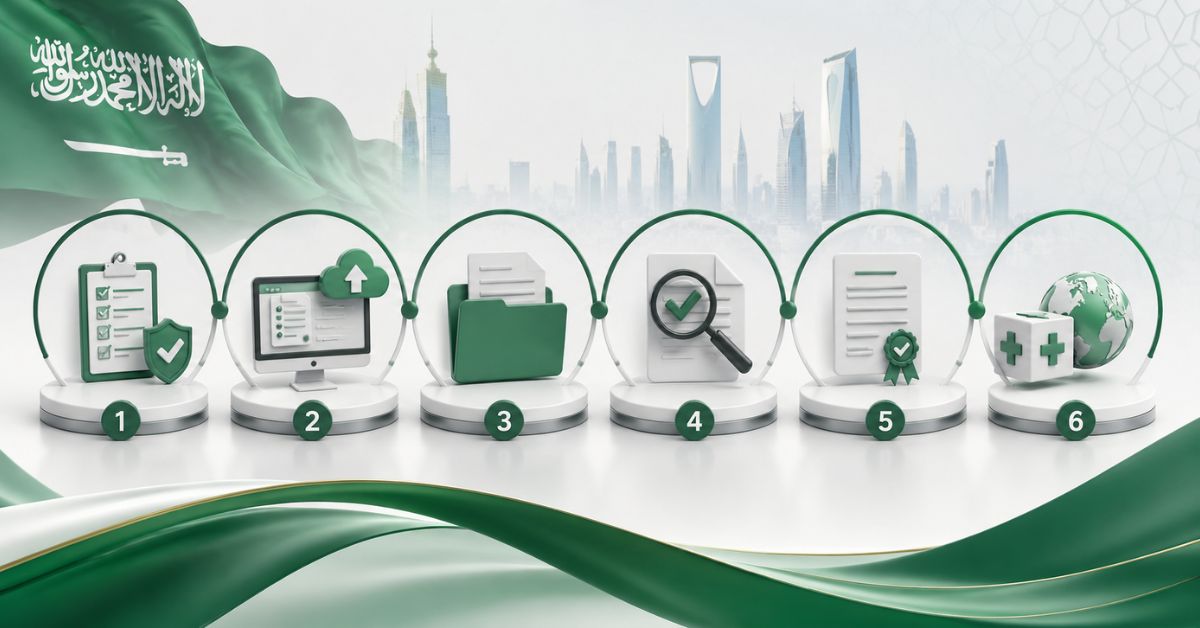
Medical Device Registration in Saudi Arabia follows six core steps: classify your device, appoint a Saudi Authorized Representative, prepare your technical file, submit through the GHAD portal, respond to SFDA review queries, and receive your MDMA certificate. The full process typically takes 3–6 months depending on device class.
Saudi Arabia is now the largest medical device market in the Middle East, driven by Vision 2030 healthcare spending and rapid hospital expansion. That growth comes with strict rules — here’s exactly how compliance works.
What Is Medical Device Registration in Saudi Arabia?
Medical Device Registration in Saudi Arabia is the legal process of obtaining a Medical Device Marketing Authorization (MDMA) from the Saudi Food and Drug Authority (SFDA) before a device can be imported, marketed, sold, or used anywhere in the Kingdom — hospitals, clinics, pharmacies, or online platforms. SFDA is the sole regulatory authority for medical devices and IVDs in the country, and a member of the International Medical Device Regulators Forum (IMDRF).
Once approved, your device is listed on the Medical Devices National Registry (MDNR), and the MDMA certificate is issued in both Arabic and English. Without it, no distributor, hospital, or warehouse in Saudi Arabia may hold or sell your product — there are no exceptions for foreign manufacturers.
Why SFDA Registration Matters
Saudi FDA Medical Device Registration isn’t a formality — it’s your legal license to operate in the Kingdom. Skipping it, or getting it wrong, carries real consequences.
- No government tenders without it. Public hospital procurement and Ministry of Health contracts require a valid MDMA.
- Non-compliance risks seizure. Devices without MDMA can be confiscated, with import bans and fines to follow.
- Gateway to the GCC. SFDA approval is widely recognized across the Gulf — UAE, Bahrain, Kuwait, Oman, Qatar — often speeding up regional expansion.
- Builds long-term trust. A valid SFDA Medical Device Registration signals your quality system and documentation meet international standards.
Medical Device Classification in Saudi Arabia
Before anything else, your device must be classified correctly. SFDA uses a risk-based system built on GHTF Classification principles and 22 classification rules for medical devices (7 for IVDs) — closely mirroring the EU MDR framework.
Low risk
Bandages, non-invasive supports Streamlined document review
Low–moderate risk
Blood pressure monitors, syringes Standard technical review
Moderate–high risk
Infusion pumps, ventilators Detailed technical + clinical review
High risk
Pacemakers, implantable devices Full file + on-site GMP inspection
6 Steps for Saudi Arabia Medical Device Registration
The complete Medical Device Registration Process used by manufacturers, importers, and consultants entering the Saudi market today.
Classify Your Device Correctly
Determine your device’s risk class (A, B, C, or D). This decision drives every requirement that follows — documentation depth, review timeline, fees, and whether an on-site inspection is required. Build your regulatory strategy around this early; reclassifying mid-process can restart the clock.
Appoint a Saudi Authorized Representative (AR)
Foreign manufacturers cannot submit an MDMA application directly. You need an in-country Authorized Representative Saudi Arabia — a Saudi-resident entity holding a valid Authorized Representative License through the GHAD system. Your AR submits and signs the application, handles adverse event reporting, manages post-market surveillance, and appears on your labeling and IFU.
Prepare Your Technical File and Documentation
This is where most delays happen. Your Technical File Assessment (TFA) must include device description, design and manufacturing details, risk management documentation, Arabic labeling for patient-facing devices, and evidence of Medical Device Quality Management — typically ISO 13485 certification. SFDA reviews the dossier independently; it does not simply accept foreign approvals.
Submit Through the SFDA GHAD Portal
Your AR submits the complete Medical Device Technical File electronically through SFDA’s Unified Electronic System (GHAD), with fees paid at submission. Devices sharing the same manufacturer, intended use, class, and design can sometimes be grouped under one application to save time and cost.
Respond to SFDA Review and Queries
Reviewers check completeness, technical accuracy, and compliance with Essential Principles of Safety and Performance. Class C and D devices may need an on-site GMP inspection. Queries are normal — a fast, thorough response is the biggest factor in avoiding a second review round.
Receive Your MDMA Certificate and Enter the Market
Once satisfied, SFDA issues the Medical Device Marketing Authorization (MDMA) and lists your device in the MDNR. Validity periods are commonly cited around 3 years — always confirm current terms with SFDA at time of application. Post-market obligations begin immediately.
Documents Required for SFDA Registration
Use this checklist to prepare your Medical Device Documentation before submission.
- Device description, specifications, and intended use statement
- Risk management file and clinical evaluation data
- ISO 13485 quality management certificate
- Labeling and Instructions for Use (Arabic where required)
- Electrical safety / EMC test reports (IEC 60601 family, for active devices)
- Sterilization validation and shelf-life data, where applicable
- Declaration of Conformity or equivalent international approval evidence
- Authorized Representative agreement and licensing documents
- Post-market surveillance and vigilance procedures
Common Challenges During Registration
- Wrong classification — applying under a lower class than the device actually qualifies for
- Incomplete Arabic translation of labels and IFUs
- Weak technical files that don’t match SFDA’s format, even when CE-compliant
- Choosing the wrong AR without checking licensing status or experience
- Underestimating post-market obligations like UDI (Saudi-DI) compliance and safety reporting
- Slow query responses, which can add months to an otherwise straightforward application
Registration Timeline & Cost
Review timelines by device class
| Device Class | Typical Review | Inspection? | Relative Cost |
|---|---|---|---|
| Class A online) | Document review only | No | Lowest |
| Class B online) | Standard technical review | Rarely | Low–moderate |
| Class C online) | Extended technical + clinical review | Often | Moderate–high |
| Class D online) | Full review + GMP inspection | Yes | Highest |
Most applications take roughly 3 to 6 months from submission to MDMA issuance, depending on submission quality and query turnaround. Medical Device Registration Cost Saudi Arabia varies by class, product grouping, and whether international GMP inspection is needed.
Expert Tips for Faster Approval
Case Study
A Mid-Size Diagnostics Manufacturer
A European ultrasound device manufacturer with no prior GCC experience initially submitted a technical file built straight from EU MDR documentation, without adapting it to SFDA’s format. Review queries stalled the process for months.
After engaging an experienced Medical Device Regulatory Consultant, the company restructured its file to match SFDA’s Essential Principles checklist, corrected its classification, and appointed a properly licensed AR. The revised submission cleared review in a single round — opening the door to hospital tenders across the Kingdom.
Why Choose a Regulatory Consultant
Navigating SFDA Requirements alone is possible, but rarely fast. An experienced Medical Device Regulatory Consultant understands current GHAD portal procedures, common rejection triggers, and how to structure a technical file for first-attempt approval.
Traccglobal is a global regulatory consulting firm specializing in Medical Device Regulatory Services across Saudi Arabia and other major markets — SFDA Regulatory Consulting, Technical Documentation, ISO 13485 Consulting, Authorized Representative coordination, and end-to-end Regulatory Affairs strategy. If you’re planning Medical Device Market Access Saudi Arabia, working with a team that manages this process daily can meaningfully shorten your path to approval.
Frequently Asked Questions
Q1. How do I register a medical device in Saudi Arabia?
Classify your device, appoint a licensed Saudi Authorized Representative, prepare a complete technical file, and submit through SFDA’s GHAD portal. After review — and inspection for higher classes — SFDA issues your MDMA certificate.
Q2. Is SFDA registration mandatory?
Yes. No medical device or IVD can legally be imported, sold, distributed, or marketed in Saudi Arabia without a valid MDMA certificate. There are no exceptions for foreign manufacturers.
Q3. Who can apply for Medical Device Registration in Saudi Arabia?
Only a Saudi-based, SFDA-licensed Authorized Representative can submit the application. Foreign manufacturers must appoint an AR to act on their behalf through the GHAD system.
Q4. How long does SFDA approval take?
Most applications take about 3 to 6 months from submission to MDMA issuance, depending on device class, documentation quality, and query turnaround.
Q5. What documents are required for Saudi Arabia Medical Device Registration?
Core requirements include device specifications, risk management files, ISO 13485 certification, Arabic labeling and IFUs, safety test reports, and Authorized Representative documentation.
Q6. Do foreign manufacturers need an Authorized Representative?
Yes, always. Every foreign manufacturer must appoint a Saudi-resident Authorized Representative holding a valid license before an MDMA application can be submitted.
Q7. How much does Medical Device Registration in Saudi Arabia cost?
Costs vary by device class, number of products grouped in one application, and whether an on-site GMP inspection is required for Class C or D devices.
Q8. What is MDMA?
MDMA stands for Medical Device Marketing Authorization — the official SFDA certificate required before any medical device can be legally marketed, sold, or distributed in Saudi Arabia.
Q9. Does CE Marking or FDA clearance help with SFDA registration?
It helps prepare documentation faster, since risk management and clinical data can be adapted. But since 2022, SFDA no longer accepts CE or FDA approval as a substitute for its own full technical file review.
Q10. What happens after I receive my MDMA certificate?
Post-market obligations begin immediately, including adverse event reporting, Unique Device Identification (UDI/Saudi-DI) compliance, and periodic safety updates until renewal is due.