
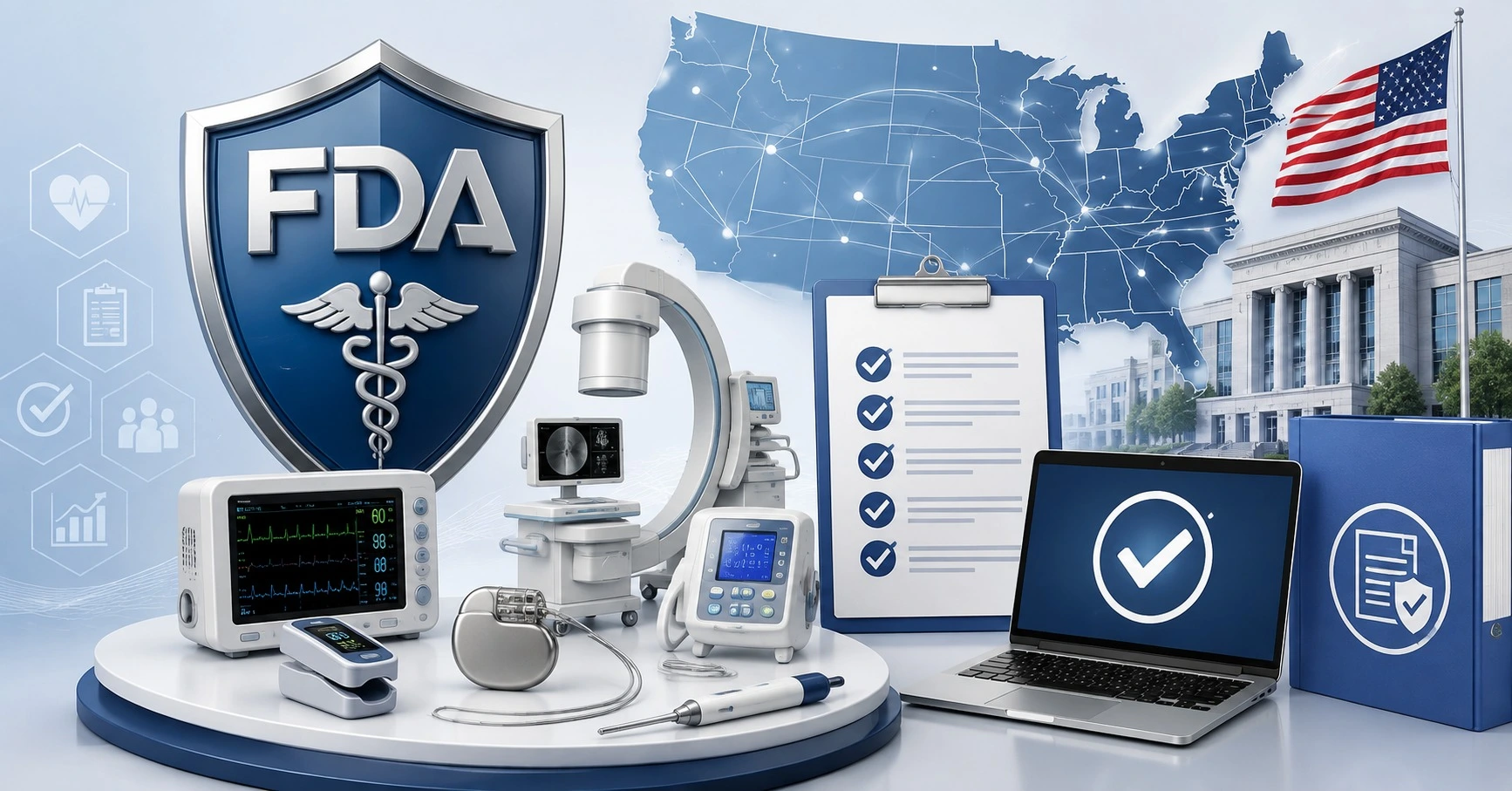
To get US FDA registration for medical devices, you must determine your device’s risk class, complete FDA establishment registration and device listing through the FURLS system, and — for most Class II devices — obtain 510(k) clearance by proving substantial equivalence to a predicate device before legally selling in the United States.
Selling a medical device in the United States is not as simple as shipping a product across the border. The U.S. Food and Drug Administration (FDA), through its Center for Devices and Radiological Health (CDRH), controls exactly which devices may enter the market and how. For manufacturers unfamiliar with the system, US FDA registration for medical devices can feel like a maze of forms, classifications, and technical jargon — 510(k), PMA, QSR, UDI — each with its own rules.
This guide breaks the entire process down in plain language. You will learn exactly what FDA registration means, who needs it, how device classification works, what documents you need, how long it takes, what it costs, and the mistakes that most often delay approval. Whether you are a startup preparing your first submission or an established manufacturer expanding into the U.S. market, this is the definitive walkthrough of the FDA medical device registration process for 2026.
What Is US FDA Registration for Medical Devices?
Quick Answer
US FDA registration for medical devices is the legal process of listing your company and your device with the FDA’s CDRH division, so the product can be lawfully marketed and sold in the United States. It includes establishment registration, device listing, and — depending on device class — premarket clearance or approval.
Definition: “FDA registration” is often used loosely to describe the entire compliance journey, but technically it refers to two specific steps: FDA establishment registration (registering your facility as a manufacturer, repackager, or importer) and FDA device listing (listing the specific device you intend to market). Neither step, by itself, means your device is “FDA approved.” A separate premarket pathway — 510(k), De Novo, or PMA — determines whether your device can actually be sold.
Explanation: Think of it in two layers. Layer one is administrative: FDA needs to know who you are and what you make. Layer two is scientific: FDA needs evidence that your device is safe and effective, or substantially equivalent to something already on the market. Most manufacturers must complete both layers before commercial launch.
Expert Insight
A recurring pattern our regulatory consultants see: overseas manufacturers assume that appearing in the FDA’s establishment registration database is equivalent to market clearance. It is not. Registration confirms FDA knows your facility exists — it says nothing about whether your specific device may legally be sold.
Who Needs FDA Registration for Medical Devices?
- Domestic manufacturers producing devices inside the United States
- Foreign manufacturers exporting devices into the U.S. market (must appoint a U.S. Agent)
- Specification developers who design a device but outsource manufacturing
- Contract manufacturers and contract sterilizers
- Repackagers and relabelers who alter labeling or packaging
- Importers bringing finished devices into the U.S. for distribution
Common Mistake
Startups frequently assume that if a distributor is “handling the FDA side,” they are personally exempt. In most structures, the manufacturer of record still carries registration and listing obligations, regardless of who distributes the product.
Understanding Medical Device Classification (Class I, II & III)
Medical device classification under FDA medical device regulations is risk-based, not price- or complexity-based. A simple-looking product can still be Class II if it touches a high-risk function.
| Class | Risk Level | Regulatory Control | Example Devices |
|---|---|---|---|
| Class I | Low | General Controls; most exempt from premarket submission | Bandages, tongue depressors, manual stethoscopes |
| Class II | Moderate | General + Special Controls; usually requires 510(k) | Infusion pumps, powered wheelchairs, diagnostic software |
| Class III | High | General Controls + Premarket Approval (PMA) | Implantable pacemakers, heart valves, high-risk implants |
Practical Tip
Search the FDA Product Classification Database using your device’s intended use and technological description before assuming a class. Two devices that look similar can carry different product codes and different obligations.
FDA Registration vs FDA Approval vs FDA Clearance (510(k))
Quick Answer
FDA registration lists your facility and device with the agency; FDA clearance (510(k)) confirms your device is substantially equivalent to an existing predicate device; FDA approv
| Term | What It Means | Applies To | FDA Language Used |
|---|---|---|---|
| Registration | Facility + device listed in FDA database (FURLS) | All manufacturers/importers | “Registered establishment” |
| Clearance (510(k)) | Substantial equivalence to a predicate device confirmed | Most Class II devices | “Cleared,” not “approved” |
| Approval (PMA) | Full review of safety and effectiveness data | Class III devices | “Approved” |
Step-by-Step FDA Medical Device Registration Process
Quick Answer
The FDA medical device registration process generally follows seven steps: classify your device, build a compliant Quality Management System, prepare technical documentation, choose and complete your regulatory pathway (510(k), De Novo, or PMA), complete establishment registration and device listing, pay applicable user fees, and maintain post-market compliance.
Determine Device Classification
Identify your device’s FDA product code and risk class (I, II, or III) using the FDA classification database and applicable regulation number under 21 CFR.
Build Your Quality Management System
Establish a QMS aligned with FDA 21 CFR Part 820 (Quality System Regulation) and ISO 13485, since documentation quality directly affects submission success.
Prepare Technical & Clinical Documentation
Assemble design controls, risk management files (ISO 14971), biocompatibility and performance testing, labeling, and Instructions for Use.
Select Your Regulatory Pathway
Choose 510(k), De Novo Classification, or Premarket Approval (PMA) based on your device class and predicate device availability.
Submit to FDA CDRH
File electronically through the FDA’s eSTAR system or Electronic Submissions Gateway (ESG) and respond to Additional Information requests.
Complete Establishment Registration & Device Listing
Register your facility and list your device annually through the FDA’s Unified Registration and Listing System (FURLS), and pay the annual establishment registration fee.
Maintain Post-Market Compliance
Comply with UDI labeling, Medical Device Reporting (MDR), QSR inspections, and change-control obligations after your device reaches the market.
Related reading: FDA 510(k) Consulting Services · FDA 21 CFR Part 820 (QSR) Guidance
FDA Registration Requirements for Medical Devices
Practical Example
Core FDA registration requirements for medical devices include a confirmed device classification, a compliant Quality Management System, complete technical documentation, U.S. Agent appointment for foreign manufacturers, payment of applicable FDA user fees, and annual renewal of establishment registration and device listing.
These requirements vary by device classification, so treat this as a baseline checklist rather than a universal formula — always confirm specifics against your product code in official FDA guidance.
- Confirmed product code and device classification (Class I, II, or III)
- Quality Management System aligned with 21 CFR Part 820 and ISO 13485
- Design History File and Device Master Record
- Labeling that meets FDA labeling requirements and UDI rules
- U.S. Agent appointed (mandatory for foreign establishments)
- Premarket submission filed where applicable (510(k), De Novo, or PMA)
- FURLS account for establishment registration and device listing
- Applicable FDA user fees paid before submission review begins
Required Documents and Information
Quick Answer
A complete FDA submission package typically includes device description and engineering drawings, proposed labeling, performance and biocompatibility test reports, a risk analysis, software documentation (if applicable), and a substantial equivalence comparison to a predicate device for 510(k) filings.
| Document | Purpose |
|---|---|
| Device Description & Drawings | Defines design, materials, and intended use |
| Substantial Equivalence Comparison | Required for 510(k); compares device to predicate |
| Biocompatibility Report (ISO 10993) | Confirms materials are safe for patient contact |
| Risk Analysis (ISO 14971) | Documents hazard identification and mitigation |
| Proposed Labeling / IFU | Must meet FDA labeling and UDI requirements |
| Software Documentation (IEC 62304) | Required for Software as a Medical Device (SaMD) |
| Sterilization Validation | Required for devices marketed sterile |
FDA Establishment Registration and Device Listing
Quick Answer
FDA establishment registration identifies your manufacturing or importing facility to the agency, while device listing identifies the specific products made or distributed at that facility. Both are completed through FURLS and must be renewed annually between October 1 and December 31.
Explanation: Establishment registration and device listing do not expire, but they must be renewed every year, and any change in ownership, address, or device portfolio must be updated promptly. Foreign establishments must also designate a U.S. Agent who serves as the FDA’s point of contact.
Practical Tip
Set an internal compliance calendar reminder for the FDA’s annual renewal window. Missed renewals are one of the most common — and most avoidable — compliance lapses among small manufacturers.
FDA 510(k) Clearance Explained
Quick Answer
FDA 510(k) clearance is a premarket notification proving a new medical device is substantially equivalent to a legally marketed predicate device. It is required for most Class II devices and is the most common regulatory pathway to the U.S. market.
Substantial equivalence rests on two pillars: the same intended use as the predicate, and either the same technological characteristics or different characteristics that raise no new safety or effectiveness questions. Choosing a weak or mismatched predicate is the single most common cause of a “Not Substantially Equivalent” decision.
| Pathway | Used For | Core Requirement |
|---|---|---|
| 510(k) | Most Class II devices | Substantial equivalence to a predicate |
| De Novo | Novel, low-to-moderate risk devices with no predicate | Risk-based classification request |
| PMA | Class III, high-risk devices | Full clinical safety and effectiveness data |
Documentation Requirements
Expert Insight
A voluntary Q-Submission (Pre-Submission) to CDRH before filing your full 510(k) can secure written FDA feedback on your predicate choice and testing plan — often preventing months of avoidable rework later in review.
Explore in depth: FDA 510(k) Consulting for Medical Devices & IVDs
FDA Compliance Requirements
Compliance is not a one-time event tied to your submission. FDA conducts routine and for-cause inspections against the Quality System Regulation, and post-market surveillance obligations apply for the life of the product.
- Quality System Regulation (21 CFR Part 820): Governs design controls, document control, CAPA, and manufacturing records
- UDI Compliance: Devices must carry a Unique Device Identifier per FDA’s UDI rule
- Medical Device Reporting (MDR): Manufacturers must report deaths, serious injuries, and certain malfunctions
- FDA Inspections: CDRH and FDA field investigators may audit manufacturing and quality records
Common Mistakes to Avoid
| Common Mistake | Best Practice |
|---|---|
| Guessing device classification | Confirm product code via FDA’s classification database first |
| Weak or mismatched predicate device | Run a documented predicate search with technological comparison |
| Incomplete biocompatibility/performance data | Run a formal gap analysis before submission |
| Missing FURLS annual renewal | Track the Oct 1 – Dec 31 renewal window on a compliance calendar |
| Calling a 510(k) device “FDA approved” | Use accurate FDA-defined language: “cleared,” not “approved” |
Timeline and Cost Considerations
| Pathway | Typical Timeline | FDA User Fee Note |
|---|---|---|
| 510(k) | 4–9 months (preparation + review) | Standard and reduced small-business fee tiers apply |
| De Novo | 8–12 months | Higher fee than standard 510(k) |
| PMA | 12–24+ months | Highest FDA user fee category |
Exact fee amounts are published annually by FDA under the Medical Device User Fee Amendments (MDUFA) and change each fiscal year — always confirm the current published figure on FDA.gov before budgeting.Exact fee amounts are published annually by FDA under the Medical Device User Fee Amendments (MDUFA) and change each fiscal year — always confirm the current published figure on FDA.gov before budgeting.
Benefits of Working with a US FDA Registration Consultant
Regulatory strategy decisions made in week one — classification, pathway, predicate — determine whether a submission takes four months or fourteen. An experienced US FDA registration consultant brings pattern recognition from dozens of prior submissions, which is difficult to replicate internally on a first attempt.
Why Choose TraccGlobal for US FDA Registration
TraccGlobal is a global medical device regulatory consultancy supporting manufacturers across classification and pathway determination, technical documentation, FDA establishment registration, device listing, and 510(k) submission support. The team works alongside a broader global regulatory practice covering CE Marking, CDSCO registration, and ISO 13485 certification — which matters for manufacturers pursuing multi-market entry rather than the U.S. alone.
TraccGlobal’s FDA regulatory approach begins with a device classification and pathway assessment before any documentation work starts, followed by a structured gap analysis against your existing technical file, and complete support through submission and FDA correspondence. For manufacturers evaluating options, TraccGlobal’s FDA 510(k) consulting practice outlines its process and typical engagement timelines in detail.
Planning Your US Market Entry?
Talk to TraccGlobal’s regulatory affairs team about your device classification, FDA registration requirements, and 510(k) pathway before you submit.
Frequently Asked Questions
What is US FDA registration for medical devices?
How long does the FDA medical device registration process take?
What are the FDA registration requirements for medical devices?
Is FDA registration the same as FDA approval?
What is FDA 510(k) clearance?
Who needs to complete FDA establishment registration?
What happens if I skip FDA registration for medical devices?
How much does FDA medical device registration cost?
Do foreign manufacturers need a U.S. Agent for FDA registration?
Why should I hire a US FDA registration consultant?
Final Thoughts
US FDA registration for medical devices is a structured, document-driven process — not a single form or a single fee. Getting classification and pathway decisions right at the start consistently determines whether a device reaches the U.S. market in months or in years. Manufacturers who invest in a clear regulatory strategy, a compliant Quality Management System, and complete technical documentation before submission tend to move through FDA review with far fewer delays.
Whether you handle FDA medical device compliance internally or work with a US FDA registration consultant, always verify current requirements, fees, and timelines directly against official FDA and CDRH guidance, since regulations and user fees are updated periodically.
Author
Reviewer
Senior FDA Regulatory Consultant, TraccGlobal
Professional Focus
US FDA, CDRH, ISO 13485, EU MDR
Editorial Policy
Reviewed against current FDA.gov guidance