
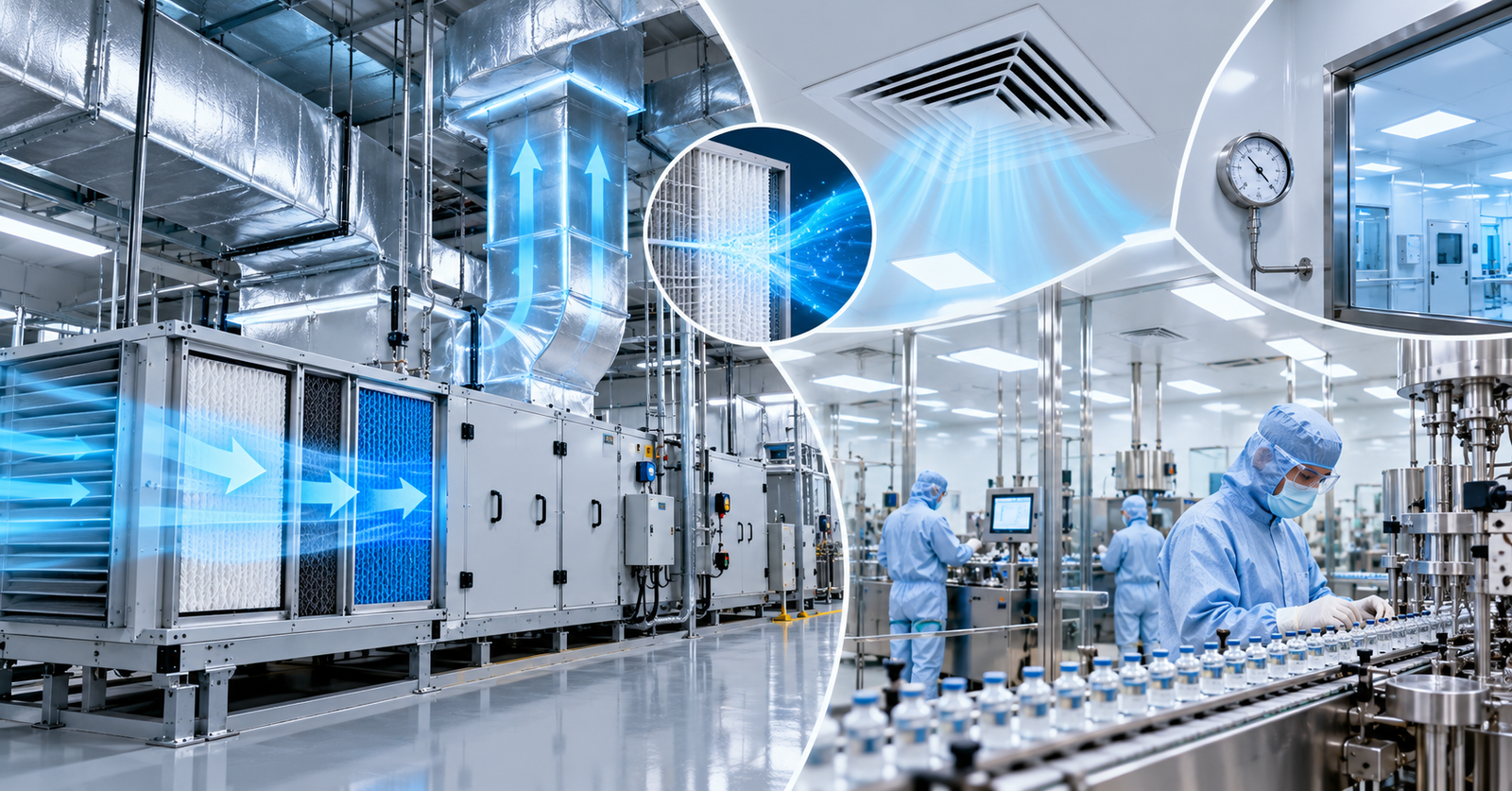
In pharmaceutical manufacturing, HVAC is a contamination-control system, not a comfort system. It helps control air cleanliness, airflow direction, pressure relationships, temperature and humidity so that products and processes stay protected. The right design depends on the facility, product, process, cleanroom classification and applicable regulations, so no single configuration fits every plant. Regulators and inspectors treat HVAC as part of the quality system: it must be designed from risk, qualified, monitored and maintained, with records to prove it. This guide explains the core requirements, where GMP guidance applies, and how to review your own facility.
Add Your Heading Text Here
Quick answer
Pharmaceutical HVAC requirements centre on filtered air of defined cleanliness, controlled pressure relationships between rooms, controlled temperature and humidity, suitable airflow patterns, monitoring and alarms, and documented qualification. Exact values come from GMP guidance, the cleanroom classification, the process and a risk assessment, not from one universal number.
What Is a Pharmaceutical HVAC System?
A pharmaceutical HVAC system is an engineered air-handling system that supplies treated, filtered air to manufacturing areas and controls pressure, temperature, humidity and airflow to protect product quality and operators. It is designed against GMP expectations and qualified for its intended use.
A typical pharma manufacturing plant system includes air handling units (AHUs), pre-, fine and terminal filters, ducting, dampers, heating and cooling coils, humidity control, exhaust and a building management system (BMS). The same components appear in comfort HVAC, but here every element is selected, documented and verified for contamination control.
Why Is HVAC Important in Pharmaceutical Manufacturing?
HVAC is important because air is a route for particles, microorganisms and cross-contamination. By controlling filtration, airflow direction and pressure, it helps protect products from contamination, protect operators from potent materials, and keep conditions suitable for materials and processes.
Product protection
Limits airborne particles and microbial load reaching exposed product.
Cross-contamination control
Keeps one product’s dust from reaching another through air, doors or shared ducts.
Process stability
Humidity and temperature can affect powders, coatings and moisture-sensitive products.
Inspection readiness
Qualification and monitoring records show the system stays in control.
Key Pharmaceutical HVAC Requirements at a Glance
The core parameters are air cleanliness, filtration, pressure differential, airflow pattern, temperature, humidity, and monitoring. Each is set by risk assessment and applicable guidance, then verified through qualification. The table summarises purpose, typical control approach and what auditors usually expect to see.
| Parameter | Purpose | Typical Control Approach | Verification Consideration |
|---|---|---|---|
| Air cleanliness | Limit particles and microbes | Multi-stage filtration, adequate supply air, defined cleanroom classification | Classification testing; environmental monitoring |
| HEPA filtration | Remove fine particles from supply air | Terminal HEPA where the risk and classification call for it | Filter integrity and leak testing, installation records |
| Pressure differential | Direct air from cleaner to less clean areas (or contain hazards) | Supply/exhaust balancing, pressure cascade, airlocks | Pressure mapping, alarm limits, trend review |
| Airflow pattern | Sweep contaminants away from critical zones | Unidirectional or non-unidirectional flow, as the operation requires | Airflow visualisation, velocity and recovery tests where relevant |
| Temperature | Product, material and operator suitability | Cooling/heating coils with control loops | Mapping, calibrated sensors, alert/action limits |
| Relative humidity | Protect moisture-sensitive materials; support process control | Humidification/dehumidification | Mapping and continuous recording |
| Monitoring and alarms | Detect drift early | BMS / environmental monitoring system | Alarm testing, data integrity, deviation handling |
What Are the GMP HVAC Requirements for the Pharmaceutical Industry?
GMP does not publish one HVAC specification. Instead, WHO, EU GMP, PIC/S, FDA and national rules require premises and air supply that prevent contamination and mix-ups, supported by qualification, monitoring and documentation. Specific expectations vary by jurisdiction and by sterile or non-sterile operations.
- WHO GMP: WHO publishes HVAC guidance for non-sterile dosage forms and GMP guidance for sterile products. Check the WHO Technical Report Series for the current editions.
- EU GMP (EudraLex Volume 4): The revised Annex 1 for sterile products applies today. It gives a guidance value of at least 10 pascals between adjacent rooms of different grades (section 4.14) and expects a documented contamination control strategy.
- FDA: The aseptic processing guidance and 21 CFR Parts 210/211 set expectations for air quality and pressure differentials. The aseptic guidance recommends a positive pressure differential between adjacent rooms of differing classification.
- PIC/S: The PIC/S GMP Guide (PE 009) is closely aligned with EU GMP and is used by many inspectorates.
- ISO 14644: Defines cleanroom classification and test methods. It is a standard, not a GMP rule, and does not replace GMP.
- India: Revised Schedule M under the Drugs Rules, notified in late 2023 to align with international GMP, applies to manufacturers in India. Reported transition periods for MSMEs ended on 31 December 2025, so confirm current applicability with CDSCO or your State licensing authority.
Requirement vs. recommendation: a “guidance value” such as 10 Pa is an expected benchmark, not a one-size mandate. Engineering best practice, such as alarm delays or sensor placement, is not law unless a regulation or your own approved procedures make it so.
GMP compliance vs GMP certification vs inspection
| Term | What it is | Who is involved |
|---|---|---|
| GMP compliance | An ongoing state: your systems meet the applicable requirements every day, not just on inspection day. | The manufacturer |
| GMP inspection | An assessment of your site against requirements at a point in time. | State drug inspectors, CDSCO officers, or a foreign regulator |
| Manufacturing licence | Legal permission to manufacture specified drugs, with GMP as a condition. | State Licensing Authority (central involvement for some categories) |
| WHO-GMP certificate | A certificate issued by the national regulator under the WHO certification scheme, generally after a joint state and CDSCO inspection. Mainly relevant for export. | CDSCO with the state authority |
| Quality management system | Your internal framework of procedures and controls. An ISO certificate for it does not replace Schedule M compliance. | You, and optionally an accredited certification body |
How a pharmaceutical company can achieve GMP compliance
Treat compliance as a project with an order of work. Finishing the steps does not guarantee approval or a certificate. The outcome depends on what inspectors find at your site.
- Gap assessment. Compare your products, licence and current facility with Schedule M and any export requirements.
- Premises assessment and design. Check layout, material and personnel flow, zoning and segregation before building or renovating.
- Equipment and utilities planning. Select equipment, HVAC and water systems to suit dosage form and batch size.
- Documentation and SOPs. Write procedures that describe what you actually do, not a generic template.
- Quality system implementation. Set up change control, deviation, CAPA, complaints, recall and supplier approval.
- Personnel and training. Confirm key personnel qualifications and run recorded GMP and role-based training.
- Equipment and system qualification. Complete design, installation and operational qualification with approved protocols and reports.
- Process, cleaning and method validation. Validate where applicable, following the validation master plan.
- Internal audit. Run a self-inspection against Schedule M and close findings.
- Inspection readiness. Do a mock inspection, check records and train staff to answer clearly and honestly.
- Continuous monitoring. Track trends, review products annually and repeat the cycle.
How Is a Cleanroom HVAC System Designed?
A cleanroom HVAC system is designed from the required classification and process risk outward: it sets supply air quality, airflow pattern, pressure cascade, zoning and environmental limits so each room maintains its classified state in operation. Personnel and material flows are planned together with the air.
Design typically begins with a user requirement specification and a contamination risk assessment, then room classifications, flow diagrams, and a pressure and airflow concept. Supply air is filtered, conditioned and delivered to rooms; return or exhaust air is routed to maintain balance and avoid recirculating contaminants where that is a risk.
Sterile versus non-sterile manufacturing
Sterile and aseptic operations protect open product in graded cleanrooms, so they use tighter classification, unidirectional airflow over critical zones, and strong monitoring. Non-sterile areas such as tablet or oral liquid manufacturing focus on dust control, cross-contamination, and controlled environments, often with less demanding air classification. Requirements differ because the contamination risk and product route differ.
What Is the Role of HEPA Filtration in Pharmaceutical HVAC?
HEPA filtration removes very fine airborne particles from supply or exhaust air and is a key element of air cleanliness in classified areas. It reduces particle and microbial carriage, but HEPA filters alone do not make a facility GMP compliant.
Filtration is usually staged: coarse pre-filters protect the AHU, fine filters reduce load, and HEPA filters, often terminal in the ceiling or at the room, provide final cleanup where the classification requires it. HEPA exhaust filtration can also protect operators and the environment for potent or hazardous products.
Installed HEPA filters are verified by integrity (leak) testing and by airflow checks, then retested periodically as defined by your risk assessment and applicable standards such as ISO 14644-3 and GMP guidance. Compliance also depends on pressure cascade, airflow pattern, gowning, cleaning, monitoring and procedures.
What Temperature and Humidity Should Be Maintained in Pharmaceutical Manufacturing?
There is no single regulatory temperature or humidity for all pharmaceutical manufacturing. Limits are defined per area from product stability, process needs, material handling and operator comfort in gowning, then justified, qualified and monitored. The defined limits must be maintained.
Humidity matters particularly for hygroscopic powders, coatings and effervescent products; temperature affects stability and operator comfort in cleanroom garments. Many facilities set alert and action limits within a justified range and map rooms during qualification to find hot, cold or humid spots. Documentation should explain how limits were chosen.
Why Is Pressure Differential Important in Pharma Cleanrooms?
Pressure differential creates directional airflow between adjacent rooms, so air moves from cleaner areas toward less clean ones, limiting contaminant entry. It can also contain hazardous dust when the cascade is reversed. It works only when doors, airlocks and air balance are controlled.
EU GMP Annex 1 gives a guidance value of at least 10 Pa between adjacent rooms of different grades, and FDA’s aseptic guidance also recommends a positive differential between classified rooms. Other pressure differences may be appropriate depending on the process, so values should be justified by risk assessment, not copied from a table.
Differentials are typically monitored with calibrated sensors and alarm limits. Because open doors and unbalanced airflow can collapse a cascade, many facilities also use interlocks and time-delay alarms. Non-sterile plants often use a mix of positive and negative relationships, for example negative pressure in a dispensing booth to contain dust.
How Do Airflow and Air Changes Support Contamination Control?
Airflow patterns and air-change rates dilute and remove contaminants generated in a room. Unidirectional flow protects critical zones, while non-unidirectional (mixed) flow suits background areas. Required air changes depend on room class, activity, heat load and recovery performance.
Air changes per hour (ACH) are a design input, not a compliance target on their own. A room with a lower ACH can still meet its limits if airflow is well distributed and sources are controlled, and a room with a high ACH can still fail. Qualification therefore looks at recovery time, airflow visualisation and particle counts alongside ACH.
How Do Zoning and Airlocks Protect Pharmaceutical Areas?
Zoning separates areas by contamination risk, product and process, often with dedicated or segregated air handling. Airlocks sit between zones to control movement of people and materials and to keep pressure relationships stable while doors open.
Common airlock concepts include “cascade” (pressure steps from clean to less clean), “sink” (lower pressure to contain) and “bubble” (higher pressure to repel). Which one fits depends on whether the aim is protecting product, containing hazardous material, or both. Separate gowning, material and waste routes reduce the chance of backtracking, and interlocked doors help preserve the pressure cascade.
How Should Fresh Air, Return Air and Exhaust Be Handled?
Fresh air replaces exhausted air and supports pressurisation, while return air recirculation saves energy but must not carry contamination between rooms. Exhaust from dusty or hazardous operations is typically filtered and routed to protect people and the environment. The strategy is set by product risk.
Recirculation is generally avoided or controlled where cross-contamination from potent, sensitising or highly hazardous materials is a risk, or where products differ. Where return air is used, filtration and risk assessment should justify it. Exhaust discharge points should be positioned to avoid re-entrainment into fresh-air intakes.
How Do HVAC Requirements Differ Across Pharmaceutical Areas?
Requirements differ because contamination risk differs: aseptic filling areas need the strictest air quality and protection, dispensing and weighing need dust containment, and storage and corridors need stable conditions and pressure relationships. The table gives the general intent, not fixed values.
| Area | Primary HVAC Intent | Typical Considerations |
|---|---|---|
| Aseptic filling / Grade A zone | Protect open sterile product | Unidirectional airflow, terminal HEPA, higher-grade background, continuous monitoring as required by Annex 1 |
| Classified cleanrooms (B/C/D) | Maintain classification and support the critical zone | Pressure cascade, ISO 14644 classification, controlled people/material flow |
| Dispensing / weighing | Contain dust, avoid cross-contamination | Local extraction or booths, often negative or balanced relative to corridor; dust filtration |
| Manufacturing (non-sterile) | Control dust and environment | Product-specific zoning, recirculation risk review, temperature/humidity limits |
| Airlocks | Keep pressure stable between zones | Interlocks, cascade/sink/bubble concept, alarm on door status |
| Corridors and support areas | Provide the pressure buffer and conditioned background | Pressure relative to adjacent rooms; avoid backflow into cleaner rooms |
| Storage | Protect materials and products | Temperature and humidity mapping and monitoring per storage label |
What Components and Monitoring Does a Pharma HVAC System Need?
A pharma HVAC system needs AHUs, staged filters, ducting, dampers, sensors, controls and a monitoring system that records pressure, temperature, humidity and alarms. Materials must be cleanable and compatible with cleaning agents, and instruments should be calibrated.
Cleanable duct and AHU surfaces, smooth sealed finishes, accessible filter housings and test ports ease maintenance and testing. A BMS or environmental monitoring system should provide trending, alarms, access control and data integrity. Alert and action limits, alarm response procedures and deviation handling should be defined before operation, and environmental monitoring (particles and microbial) complements HVAC readings.
What Is HVAC Qualification and Validation in the Pharmaceutical Industry?
HVAC qualification is the documented evidence that the system is designed, installed, operates and performs as intended. It usually follows design, installation, operational and performance stages, with defined acceptance criteria, followed by monitoring and periodic verification.
- Design qualification (DQ): confirms the design meets user requirements and GMP expectations, where applied.
- Installation qualification (IQ): verifies components, drawings, calibration and materials as installed.
- Operational qualification (OQ): tests functions: airflow, pressure control, alarms, interlocks, filter integrity.
- Performance qualification (PQ): shows consistent performance in use, including particle and, where relevant, microbial monitoring, temperature and humidity.
Terminology and expected depth differ across frameworks, so align your protocols with the standard your regulator applies. Deviations during testing must be recorded and resolved. Requalification or periodic verification is typically triggered by a defined schedule or by changes such as filter replacement, layout changes or repeated excursions, as set in your change-control and risk procedures.
How Should a Pharmaceutical HVAC System Be Maintained?
Maintain pharmaceutical HVAC through a documented preventive maintenance programme: filter checks and replacement, coil and fan inspection, sensor calibration, periodic integrity testing and change control. Maintenance must not compromise qualified status, and its records form part of the quality system.
Differential pressure across filters, airflow readings and alarm trends can reveal loading or drift before a failure. After major maintenance or filter replacement, assess whether retesting is needed under change control.
What Are Common Pharmaceutical HVAC Design Mistakes?
Common mistakes include weak zoning, inconsistent pressure relationships, poor airflow planning, inadequate filtration strategy, limited monitoring and thin documentation. Most trace back to starting with equipment selection before defining product risk and user requirements.
Inadequate zoning
Mixed-risk areas share air paths. Zone by product and process risk.
Wrong pressure relationships
Cascades reverse during door openings. Model flows and use airlocks.
Poor airflow planning
Inadequate monitoring
Weak documentation
Ignoring cross-contamination
Poor maintenance and validation planning
Weak filtration strategy
Pharmaceutical HVAC Compliance and Design Checklist
Use this checklist to review whether your pharma HVAC design has covered classification, zoning, pressure, environmental control, filtration, monitoring, qualification and documentation. A “no” or “unsure” answer marks an item for risk assessment, not an automatic non-compliance.
- Product, process and contamination risks assessed; URS approved.
- Cleanroom classification defined for every room, with a sterile vs non-sterile rationale.
- Zoning, personnel, material and waste flows mapped; airlocks defined.
- Pressure cascade documented, with justified differentials and door/interlock strategy.
- Temperature and humidity limits justified per area, with alert and action limits.
- Filtration stages defined; HEPA location, integrity testing and exhaust protection addressed.
- Airflow patterns and air-change rates justified and verifiable.
- Return air and exhaust strategy reviewed for cross-contamination.
- Monitoring and alarm system defined, calibrated and data-integrity assessed.
- DQ/IQ/OQ/PQ protocols with acceptance criteria prepared; deviation handling defined.
- Preventive maintenance, change control and requalification triggers documented.
- Applicable regulations confirmed (e.g. WHO, EU GMP, PIC/S, FDA, revised Schedule M) and gaps recorded.
How TRACC Global Can Support Pharmaceutical Regulatory and Compliance Requirements
HVAC design and qualification are engineering and validation activities, while regulatory strategy connects them to licensing, inspections and market access. TRACC Global is a pharmaceutical regulatory consulting brand that helps manufacturers understand the regulatory context around their facility and compliance goals.
If you are planning a new facility, upgrading an existing one, or preparing for registration or export, you can contact TRACC Global to discuss how your HVAC and facility documentation fits your regulatory pathway. HVAC engineering design and on-site qualification should be performed by qualified engineering and validation specialists.
Frequently Asked Questions
What are the HVAC requirements for pharmaceutical manufacturing facilities?
What are GMP HVAC requirements for the pharmaceutical industry?
What is the role of HEPA filtration in pharmaceutical HVAC?
Why is pressure differential important in pharma cleanrooms?
What temperature and humidity should be maintained in pharmaceutical manufacturing?
What is a cleanroom HVAC system?
How does HVAC prevent contamination in pharmaceutical manufacturing?
What is HVAC qualification and validation in the pharmaceutical industry?
How does HVAC design differ for sterile and non-sterile pharmaceutical manufacturing?
What should be checked before qualifying a pharmaceutical HVAC system?
Planning or upgrading a pharmaceutical facility?
Talk to TRACC Global about the regulatory side of your compliance plan.