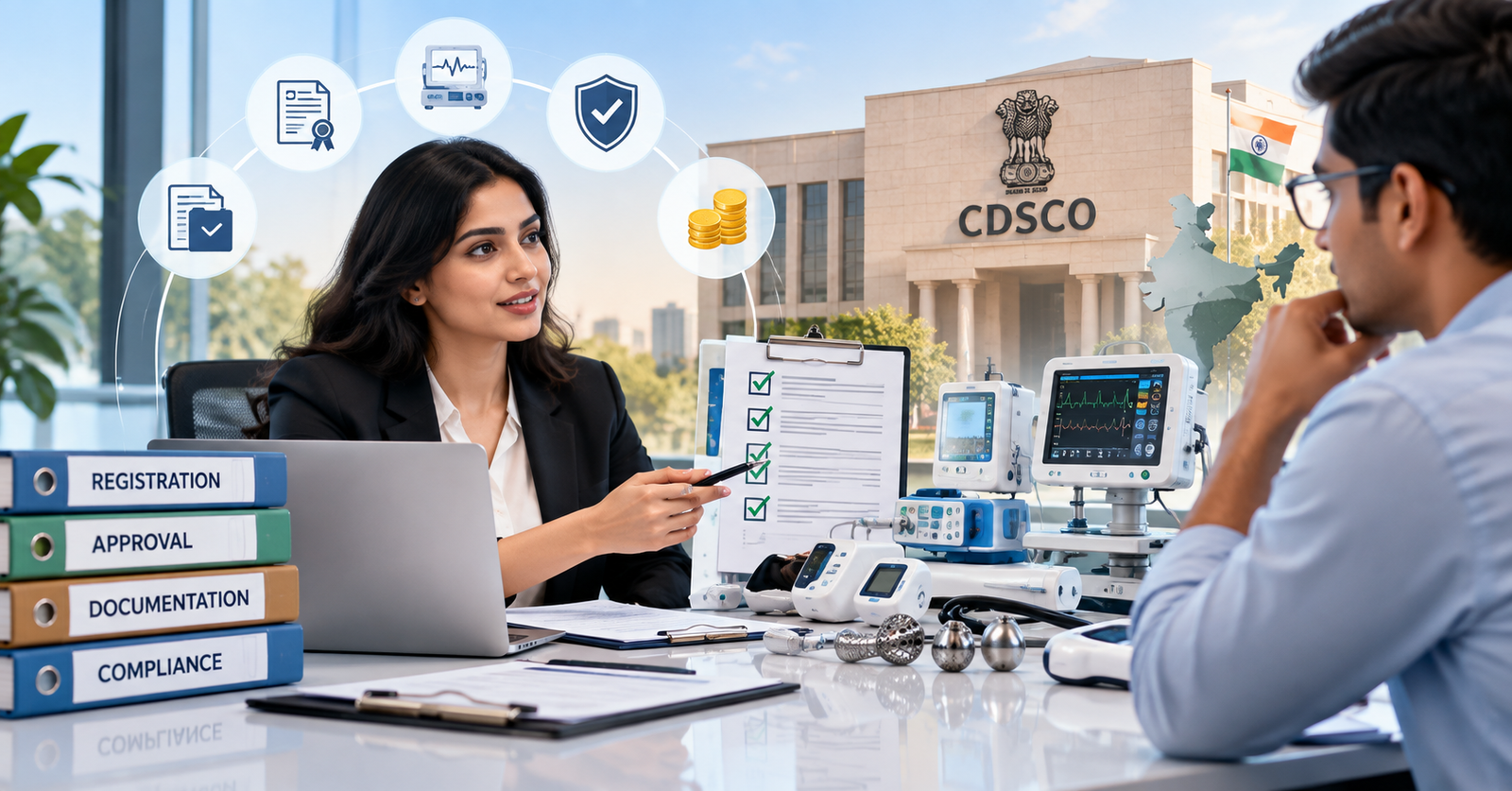
Why hire a medical device regulatory consultant?
A medical device regulatory consultant helps you understand which Indian rules apply to your device, choose the right pathway, prepare accurate documents and stay compliant after approval. The consultant does not grant approval. CDSCO and the State Licensing Authorities decide. A good consultant helps you apply correctly and prepared.
Since 2020, all medical devices in India are regulated under the Medical Devices Rules, 2017 (MDR 2017). Rules, lists and portal features keep changing. For a manufacturer, importer or startup, one wrong class or one missing paper can mean refiling and lost months.
Below are seven practical benefits of working with a regulatory consultant, along with honest limits. Exact requirements depend on device class, intended use and whether you manufacture or import, so always confirm with current CDSCO notices.
Consultant vs CDSCO: who does what?
| Role | Who | Typical tasks |
|---|---|---|
| Regulator | CDSCO (Central Licensing Authority) and State Licensing Authorities | Classifies devices, reviews applications, inspects, grants or refuses licences |
| Consultant | Independent regulatory firm or expert | Strategy, gap review, dossier preparation, filing support, query replies, compliance guidance |
| Applicant | Your company | Owns the application, signs declarations, holds the licence and its duties |
Consultant, testing lab, notified body, regulator: who does what?
| Role | What it does | Can it grant a licence? |
|---|---|---|
| Medical device consultant / regulatory affairs consultant | Advises, plans strategy, prepares and files documents, coordinates | No |
| Certification consultant | Helps you prepare for standards such as ISO 13485; may not cover CDSCO filings | No |
| Testing laboratory | Tests devices against standards and issues test reports | No |
| Notified body (under MDR 2017) | Audits manufacturing sites of certain low-risk devices for QMS conformity, when accredited and applicable | No, it audits |
| CDSCO / State Licensing Authority | Reviews applications and grants licences under MDR 2017 | Yes |
1
You know which rules apply to your product
What it is: a clear view of whether your product is a “medical device” under MDR 2017 and which duties follow.
Why it matters: the definition covers instruments, implants, software and some diagnostics. Intended use decides. CDSCO says a massager meant only for soothing or wellness is outside the rules, but one meant for therapy or relief of disease is inside them.
How a consultant helps: reviews your intended use, claims and labels against the definition and CDSCO lists, then maps duties such as licence or registration, quality management system (QMS), labelling and post-market reporting.
Without it: you may sell a regulated product unlicensed, or spend money on approvals you do not need.
Example: a startup sells a handheld massager, then prints “relieves arthritis pain” on the box. That claim may change its regulatory status. A consultant would flag this before the label is printed.
2
You choose the right class and pathway
What it is: matching your device to a risk class (A to D) and the correct application route.
Why it matters: class decides the authority. State Licensing Authorities handle manufacture of Class B and most Class A devices. The Central Licensing Authority handles Class C and D manufacture and all imports. Only the Central Licensing Authority classifies devices, and CDSCO’s portal has a provision to apply for risk classification.
How a consultant helps: checks CDSCO’s classification lists, prepares the justification if your device is not listed, and reviews how the product is classed abroad. For imports, CDSCO may apply the higher class if India and other markets differ.
Without it: wrong forms, wrong authority and fees that CDSCO says are not refundable.
Example: an importer assumes “low risk” because its home market says so. India’s list may place the device higher, and the plan changes.
3
Registration and licensing steps are planned properly
What it is: support with the actual applications: import licence (application Form MD-14, licence Form MD-15), manufacturing licence, test licences for prototypes, and registration for Class A non-sterile, non-measuring devices.
Why it matters: each route has its own forms, fees and documents. Fees apply per brand. Overseas manufacturers must work through an Indian authorised agent under a power of attorney. Applications are filed online on CDSCO’s Medical Devices Online portal.
How a consultant helps: lists the right route, forms, fees and order of steps, and coordinates the authorised agent and your team.
Without it: small formal gaps get missed.
Example: an overseas firm files a power of attorney that is not authenticated as required, such as by apostille. The application stalls on paperwork, not on the device.
4
Your documents are complete and consistent
What it is: a review and build-up of the technical file, such as the Device Master File, Plant Master File, QMS evidence, free sale certificate, labels, instructions for use and test data.
Why it matters: reviewers compare documents against each other. For example, CDSCO expects the free sale certificate to show both legal and actual manufacturer details. Shelf-life claims need real-time ageing data, or accelerated data with a real-time study running.
How a consultant helps: runs a gap check, aligns names, addresses and specifications across every document, and points out missing evidence before filing.
Without it: mismatches invite queries that could have been avoided.
5
You reduce avoidable errors and delays
What it is: fewer rework cycles caused by your own mistakes, not by the review itself.
Why it matters: delays often come from incomplete files, wrong class or late replies to queries.
How a consultant helps: uses a pre-filing checklist, tests your file the way a reviewer would, and prepares clear replies to queries.
Reality check: a consultant cannot shorten CDSCO’s review. The rules allow up to nine months to grant an import licence when documents are satisfactory. Treat any promise of a quick fixed timeline with caution.
6
Someone manages submissions and regulator communication
What it is: day-to-day handling of filing, tracking, queries, inspections and notified body audits.
Why it matters: a missed query or inspection request can stall a file. For Class B, C and D manufacture, the manufacturing site is audited or inspected before the licence, and for Class A and B the State Licensing Authority assigns the notified body. You cannot choose it.
How a consultant helps: keeps a query log, drafts replies, prepares your team for audits and keeps one clear owner for the file. CDSCO says only an authorised person of the company can ask about application status, so set up written authorisation properly.
Without it: nobody owns the file, and deadlines slip between teams.
7
Compliance continues after the licence
What it is: support with duties that begin once you hold a licence.
Why it matters: under MDR 2017 a licence stays valid until suspended or cancelled, provided the retention fee is paid every five years. The licence holder must report post-marketing surveillance data. Major post-approval changes need approval, while minor ones are informed within 30 days. A change in company constitution must be informed within 45 days, with a fresh application within 180 days.
How a consultant helps: sets a compliance calendar, classifies changes as major or minor, prepares change filings and tracks amendments. Draft Medical Devices (Amendment) Rules, 2026 were published for comment, so check the final status on CDSCO and Gazette pages.
Example: an overseas manufacturer switches its Indian authorised agent. CDSCO’s FAQ says a change of agent needs a fresh import licence, so timing matters.
When should you hire a regulatory consultant?
Consider help at these points:
- You plan to enter the Indian market as a manufacturer or importer.
- You are launching a new device or changing its intended use or claims.
- Your device class or pathway is unclear.
- You are preparing a Device Master File, Plant Master File or QMS.
- You received queries and need a clear reply plan.
- You are changing site, ownership or Indian agent.
Not every business needs one. A team with strong in-house regulatory staff, or a simple Class A non-sterile registration, may manage alone. Early advice is usually cheaper than fixing a wrong filing.
What to look for in a medical device regulatory consultant
| Check | Ask this |
|---|---|
| MDR 2017 and CDSCO knowledge | How do you decide class and pathway for my device? |
| Device experience | Have you handled devices like mine, and what was your role? |
| Documentation skill | Can I see a sample gap report (with client details removed)? |
| Submission support | Who files, who signs, and who replies to queries? |
| Transparency | Do you avoid guarantees and give scope and fees in writing? |
| Communication | Who is my contact, and how often will I get updates? |
| Post-approval support | Do you help with retention, changes and audits? |
Read Also: CDSCO Compliance Challenges in India
How TRACC Global can help
According to its website, TRACC Global is a regulatory consultancy serving healthcare and medical device companies. Its listed services include CDSCO medical device registration support, import licence preparation, ISO 13485 and QMS work, Indian authorised agent coordination, and CE marking and US FDA support. See its product services page for the full list.
Before you sign with any firm, ask for the exact scope, deliverables and fees in writing. For background reading, see what is CDSCO.
Key takeaways
- Consultants advise and prepare. CDSCO and State Licensing Authorities decide.
- Class, pathway and documents decide most of your workload.
- Compliance continues after the licence.
- Avoid any promise of guaranteed approval or fixed timelines.
Frequently Asked Questions
What does a medical device regulatory consultant do?
A consultant advises on applicable rules, class and pathway, prepares technical documents, supports filing and query replies, and guides compliance after approval. The company stays responsible for its application and licence.
Why should a medical device company hire a regulatory consultant?
To avoid preventable errors such as wrong classification or inconsistent documents, and to keep compliance on track after licensing. It does not guarantee approval or speed.
Can a consultant help with CDSCO approval?
Yes, with preparation, documentation, filing support and coordination. Only CDSCO or the relevant State Licensing Authority can grant a licence. A consultant cannot approve anything.
Can a regulatory consultant help with medical device registration?
Yes. Support can include checking whether you need registration or a licence, preparing documents and using the Medical Devices Online portal. Requirements vary by class and by manufacture or import.
What is the role of a CDSCO regulatory consultant?
A CDSCO regulatory consultant helps you meet CDSCO requirements under MDR 2017 through strategy, documents, submissions and compliance guidance. The role is advisory, not governmental.
When should a medical device company hire a consultant?
Ideally early: before entering India, launching a device, fixing claims or class, or building the technical file. Later triggers include queries, site changes and ownership or agent changes.
How does a regulatory consultant help with compliance?
By tracking retention fees, post-approval changes, labelling and reporting duties, and updates to the rules. This helps improve regulatory preparedness. It does not remove risk entirely.
Company credentials
ISO 9001, ISO 27001 & ISO 45001 certified consultancy
Contact
info@traccglobal.com