Table of Contents
Our Services
Connect With Us
Short answer:
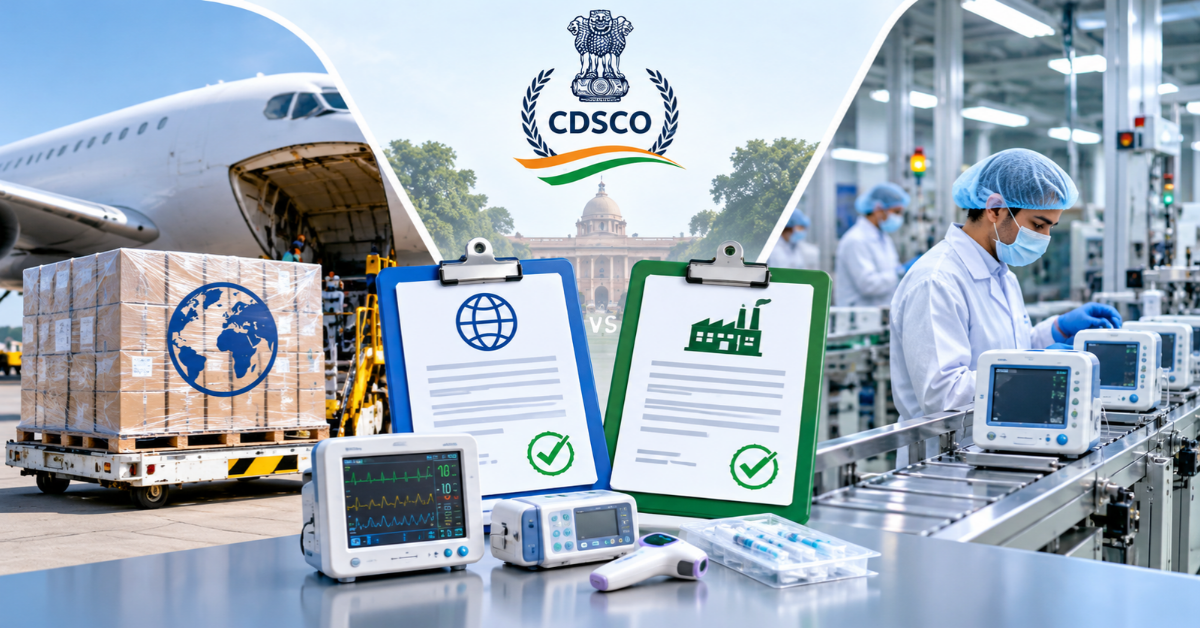
The difference between a CDSCO import license and a manufacturing license comes down to where the device is made. A medical device import license (application in Form MD-14, licence in Form MD-15) lets an Indian authorised agent bring in devices made at an overseas site. It is always granted by the Central Licensing Authority, whatever the risk class. A medical device manufacturing license covers devices made at a site in India. For Class A and B it is granted by the State Licensing Authority (Form MD-3 → MD-5), and for Class C and D by the Central Licensing Authority (Form MD-7 → MD-9). Import licensing reviews the foreign manufacturer and its site. Manufacturing licensing checks your own Indian facility and its quality management system through an audit or inspection.
Class A devices that are both non-sterile and non-measuring do not need either licence. They are registered on CDSCO’s online system instead.
The Medical Devices Rules, 2017 (MDR 2017) govern medical devices in India, and CDSCO now requires a licence for every device that is imported, manufactured, sold or distributed, with a few listed exemptions. One of the first questions any device business has to answer is which licence applies. Importers, Indian manufacturers and foreign companies entering India often treat the two routes as interchangeable. They are not. They differ in who applies, who decides, what is inspected, how much the government charges and how long a decision can take.
This guide covers both routes side by side, using the rules and CDSCO documents listed at the end.
What is a CDSCO medical device import licence?
A CDSCO medical device import licence authorises an Indian entity to import specified medical devices made at a specified overseas manufacturing site. The application is filed in Form MD-14, and the Central Licensing Authority (the Drugs Controller General of India) grants the licence in Form MD-15. Every class of device, from A to D, goes to the Central Licensing Authority.
A foreign manufacturer cannot hold the licence itself. Under Rule 34(1), the application is made by an authorised agent in India. The agent must hold a manufacturing licence, a wholesale licence for sale or distribution, or a registration certificate in Form MD-42. The agent becomes responsible in India for the imported devices, including post-market obligations.
TRACC Global’s CDSCO import license service covers this route in more detail.
What is a CDSCO medical device manufacturing licence?
A CDSCO medical device manufacturing licence authorises a company to manufacture specified medical devices for sale or distribution at a named manufacturing site in India. The authority that grants it depends on the device’s risk class:
- Class A and Class B: the application goes to the State Licensing Authority in Form MD-3, and the licence is issued in Form MD-5. A loan licence uses Form MD-4 and is issued in Form MD-6.
- Class C and Class D: the application goes to the Central Licensing Authority in Form MD-7, and the licence is issued in Form MD-9. A loan licence uses Form MD-8 and is issued in Form MD-10.
A manufacturing licence focuses on your own site. The authorities check whether your facility and quality management system meet the Fifth Schedule of MDR 2017. A notified body audits Class A and B sites, and a CDSCO inspection team inspects Class C and D sites. TRACC Global’s CDSCO manufacturing license page covers that route.
CDSCO import license vs manufacturing license: comparison table
| Point of Difference | Import Licence | Manufacturing Licence |
|---|---|---|
| Where the Device Is Made | Overseas manufacturing site | Manufacturing site in India |
| Who Applies | Indian authorised agent with a manufacturing licence, a wholesale licence or an MD-42 registration (Rule 34) | The Indian manufacturer (or a loan licensee using another licensed facility) |
| Application → Licence Form | MD-14 → MD-15 | Class A/B: MD-3 → MD-5 (loan: MD-4 → MD-6) Class C/D: MD-7 → MD-9 (loan: MD-8 → MD-10) |
| Licensing Authority | Central Licensing Authority for all classes | Class A/B: State Licensing Authority Class C/D: Central Licensing Authority |
| Site Assessment | Document review. CDSCO may inspect the overseas site (Rule 35) | Class A: notified-body audit within 120 days after grant Class B: notified-body audit before grant Class C/D: inspection before grant |
| Approval in Another Country | A free sale certificate is a core document. Clinical-investigation needs depend on where it was issued (Rule 36) | Not a prerequisite. Evidence of safety and performance is still needed, and new devices follow separate permission routes |
| Government Fee | Charged in US dollars, per overseas site plus per device | Charged in rupees, per Indian site plus per device |
| Decision Timeline in the Rules | Within nine months of application (Rule 36) | Varies by class (see below). A draft amendment of June 2026 proposes shorter timelines |
| Validity | Perpetual unless cancelled or surrendered, with a retention fee every five years (Rule 37) | Perpetual, with a retention fee every five years (Rule 29) |
CDSCO import license requirements for medical devices
1. An eligible Indian authorised agent
The foreign manufacturer appoints an Indian authorised agent through a power of attorney. The agent must already hold a manufacturing licence, a wholesale licence or a Form MD-42 registration certificate. MD-42 is the registration for selling, stocking or distributing medical devices, issued by the State Licensing Authority on an application in Form MD-41.
2. A free sale certificate and the Rule 36 conditions
Rule 36 links clinical evidence to the countries where the device is already approved:
- If the free sale certificate comes from Australia, Canada, Japan, a European Union country, the United Kingdom or the United States, the import licence can be granted without a clinical investigation in India.
- If it comes from another country, Class C and D devices need their safety and effectiveness established through a clinical investigation in India. Class A (other than non-sterile and non-measuring) and Class B devices need published data or clinical investigation in the country of origin, along with that country’s free sale certificate.
- An investigational device needs prior permission in Form MD-27, and a new IVD needs prior permission in Form MD-29.
Government fee (per overseas site + per device)
| Device Category | Per Overseas Site | Per Distinct Device |
|---|---|---|
| Class A (non-IVD)* | USD 1,000 | USD 50 |
| Class B (non-IVD) | USD 2,000 | USD 1,000 |
| Class C or D (non-IVD) | USD 3,000 | USD 1,500 |
| Class A or B IVD* | USD 1,000 | USD 10 |
| Class C or D IVD | USD 3,000 | USD 500 |
CDSCO medical device manufacturing license requirements
1. A Fifth Schedule-compliant site and QMS
The Fifth Schedule sets out the quality management system requirements for medical devices and IVDs. Your premises, processes, records, validation and documentation all need to meet it. In practice, many manufacturers build their system on ISO 13485. See our ISO 13485 QMS support for more.
2. Audit or inspection by risk class
Class A (sterile or measuring)
- State Licensing Authority decides within 45 days
- No audit before grant
- Notified-body audit within 120 days after grant
Class B
- Notified-body audit before grant, within 90 days of application
- Audit report within 30 days
- Decision within 20 days of the report
Class C and D
- Central Licensing Authority scrutiny within 45 days
- Site inspection within 60 days of application
- Decision within 45 days of the inspection report
3. Government fee (per Indian site + per device)
| Device Class | Per Site | Per Distinct Device |
|---|---|---|
| Class A* or Class B | ₹5,000 | ₹500 |
| Class C or Class D | ₹50,000 | ₹1,000 |
*Other than non-sterile and non-measuring. A test licence to manufacture costs ₹500 for each distinct device.
4. Labelling and post-licence duties
Licensed manufacturers must meet the labelling rules and keep up QMS records, complaint handling and post-market obligations. A 2026 amendment (G.S.R. 743(E)) added a labelling requirement for outsourced sterilisation. Confirm how it applies to your device and the date it takes effect.
Not sure which route applies to your device? Share the device name, intended use and where it is made, and TRACC Global’s regulatory team will help you confirm the classification and licensing route.
Documents required: import vs manufacturing
The Fourth Schedule of MDR 2017 sets out the documents. Mandatory marks a core document for that route. Conditional means it depends on the device, its class or its history.
Documents required for a CDSCO import licence
- Form MD-14 with the fee Mandatory
- Power of attorney from the foreign manufacturer and the agent’s undertaking Mandatory
- Agent’s manufacturing or wholesale licence, or MD-42 registration (self-attested) Mandatory
- Free sale certificate and overseas site registration (notarised) Mandatory
- QMS / full quality assurance certificate (notarised) Mandatory
- Plant / Site Master File (Appendix I) Mandatory
- Device Master File (Appendix II, or Appendix III for IVDs) — Class B, C, D Conditional
- Labels, IFU and essential principles checklist Mandatory
- Inspection or audit report from the last three years, if any Conditional
- Clinical data or permission (Rule 36 / MD-27 / MD-29) Conditional
Documents required for a CDSCO manufacturing licence
- Form MD-3 (A/B) or MD-7 (C/D) with the fee Mandatory
- Constitution details of the firm Mandatory
- Plant / Site Master File (Appendix I) Mandatory
- Device Master File (Appendix II, or Appendix III for IVDs) — Class B, C, D Conditional
- Essential principles checklist Mandatory
- Undertaking of Fifth Schedule (QMS) compliance Mandatory
- Test licence and QC data from test batches, if any Conditional
- Validation, biocompatibility, sterilisation and stability data, as applicable Conditional
- IVD performance evaluation report Conditional
This checklist summarises the requirements and does not replace the Fourth Schedule. The exact list depends on the device’s class, whether it is an IVD and whether it has a predicate.
How to work out which CDSCO licence you need
- Confirm the device is a medical device and find its class. Check CDSCO’s published classification lists. If your device is not listed, CDSCO’s online system has had a risk-classification request module since 27 November 2025.
- Check whether it is Class A non-sterile and non-measuring. If so, use the registration route under Chapter IIIB. Since a 2026 amendment (G.S.R. 744(E)), this route also requires self-certifying compliance with a QMS.
- Find out where it is made. A device made overseas follows the import route. A device made in India follows the manufacturing route. A business that does both needs both licences.
- Check special cases. These include devices with no predicate (Form MD-26 → MD-27), imports or manufacture only for testing or evaluation (test licences MD-16/MD-17 and MD-12/MD-13), and raw materials or components imported for manufacture under a valid manufacturing licence. CDSCO FAQs address components, so confirm your own case.
- Plan for selling. Distributors and sellers need an MD-42 registration from the State Licensing Authority.
Example: a European importer
A German manufacturer of a Class C device appoints an Indian distributor that holds MD-42 as its authorised agent. The agent files MD-14. The EU free sale certificate means no clinical investigation in India is required under Rule 36.
Example: an Indian startup
A Pune startup making a Class B monitor applies to its State Licensing Authority in MD-3. A notified body audits the site before the licence is granted in MD-5.
Example: import and manufacture
A company imports one Class D implant range and makes Class A sterile dressings in Gujarat. It needs an MD-15 licence for the imports and an MD-5 licence from the state for the dressings.
Application process: step by step
Applications are made online through CDSCO’s online system for medical devices (cdscomdonline.gov.in) or the National Single Window System (nsws.gov.in).
Import route
- Classify the device and confirm the free sale position
- Appoint and qualify the authorised agent
- Prepare the PMF, DMF and legal documents
- File MD-14 online and pay the fee in USD
- Answer CDSCO queries and any site-inspection request
- Receive the MD-15 licence, then pay retention every five years
Manufacturing route
- Classify the device and finalise the site layout
- Set up a Fifth Schedule QMS and validate processes
- Prepare the PMF, DMF and test data
- File MD-3 or MD-7 online and pay the fee in INR
- Go through the notified-body audit or CDSCO inspection
- Receive the MD-5 or MD-9 licence, then pay retention every five years
Common compliance mistakes
- Assuming an overseas approval replaces an Indian licence. It does not. It only affects the clinical-evidence route under Rule 36.
- Appointing an agent without the right licence. Rule 34 requires the agent to hold a manufacturing licence, a wholesale licence or an MD-42 registration.
- Treating licences as expiring after a fixed term. MDR licences are perpetual, but a retention fee is due every five years. Late payment draws a penalty, and if the fee stays unpaid the licence is deemed cancelled.
- Getting the class wrong. The class decides the forms, the authority, the fee and whether there is an audit. Use CDSCO’s lists or its classification module.
- Underestimating site readiness. For manufacturing, the audit or inspection checks what actually happens on the shop floor against your QMS documents. See our guide to mistakes that delay CDSCO approval.
- Using old fee tables or portal names. Pay the fee shown on CDSCO’s current schedule and file on the online system for medical devices.
How a regulatory consultant can help
Some companies file on their own. Others bring in a consultant, especially when the device is new to India, spans several classes, or needs a facility built from scratch. A medical device regulatory consultant in India can help with:
- Classification and route assessment (import, manufacturing or both)
- Preparing the Device Master File and Plant Master File
- Gap assessment of an existing CE or FDA dossier against Indian requirements
- QMS setup and readiness for audit or inspection (QMS services)
- Facility planning for new manufacturers (turnkey project services)
- Responding to queries and handling post-approval changes
A consultant cannot guarantee approval or a timeline, because CDSCO and the State Licensing Authorities make the decisions. What a good consultant can do is cut avoidable errors and rework.
Discuss your CDSCO licensing route with TRACC Global
Whether you plan to import, manufacture or both, tell us about your device and TRACC Global’s regulatory team will help you map the applicable licence, documents and next steps.
Phone: +91 88688 86774 · Email: info@traccglobal.com
Frequently Asked Questions
Can a foreign manufacturer apply for a CDSCO import licence directly?
No. The application in Form MD-14 is made by an Indian authorised agent that holds a manufacturing licence, a wholesale licence or an MD-42 registration certificate.
Who grants a medical device manufacturing licence in India?
The State Licensing Authority grants it for Class A and B devices (Form MD-5). The Central Licensing Authority grants it for Class C and D devices (Form MD-9).
Do I need both licences?
Only if you both import finished devices and manufacture devices in India. Each licence covers its own devices and sites.
How long is a CDSCO import or manufacturing licence valid?
Both are perpetual, provided the retention fee is paid every five years, and unless the licence is suspended, cancelled or surrendered.
How long does CDSCO take to decide an import licence?
Rule 36 requires a decision within nine months of the application. The actual time depends on how complete the file is and on any queries or inspection.
Do Class A medical devices need a licence?
Class A devices that are sterile or have a measuring function need a licence. Class A devices that are both non-sterile and non-measuring are registered on CDSCO’s online system instead.
Do Class A medical devices need a licence?
MDR 2017 requires compliance with its Fifth Schedule QMS. ISO 13485 is widely used to meet it, but the legal requirement is the Fifth Schedule.
Where do I apply?
Applications are made through CDSCO’s online system for medical devices (cdscomdonline.gov.in) or the National Single Window System (nsws.gov.in).